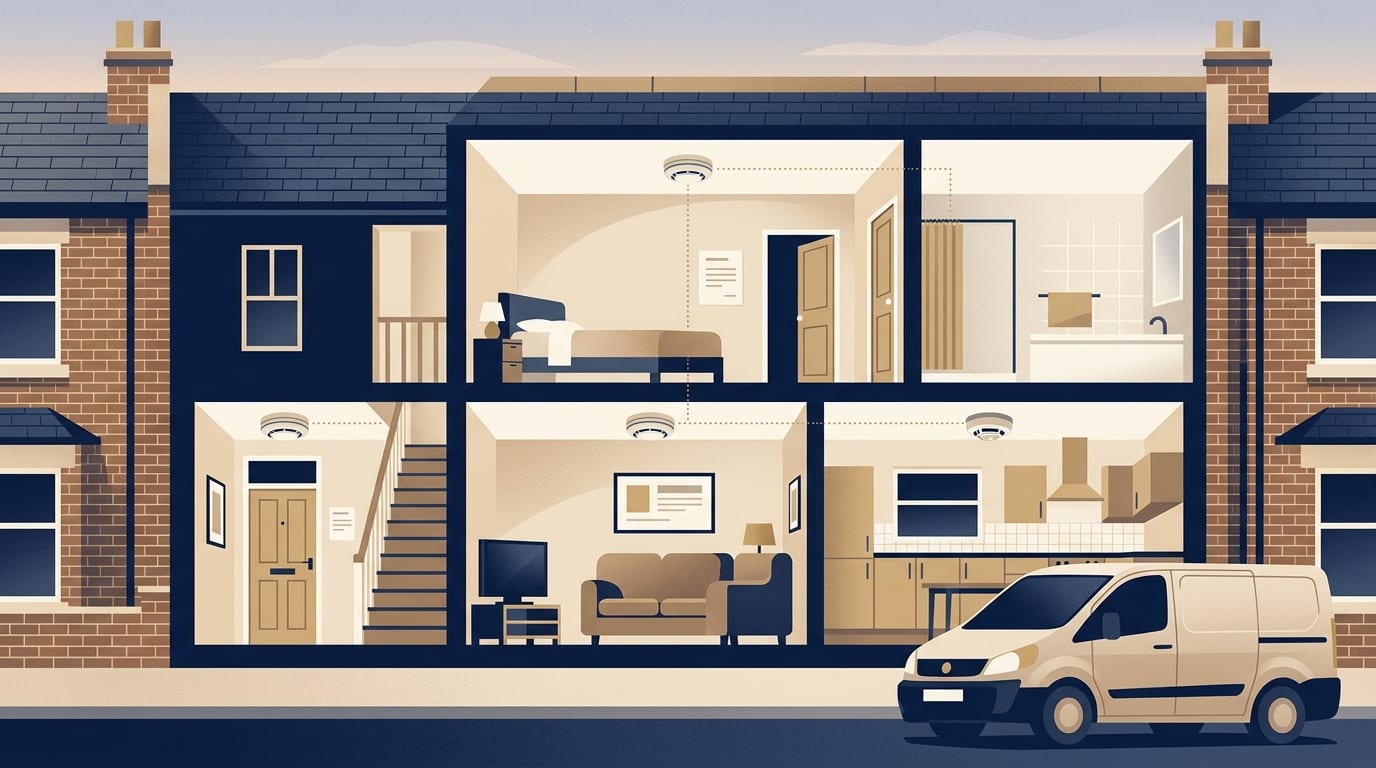
The rules on smoke alarms depend entirely on where you live and whether you rent out the property. In Scotland, every home must have a system of interlinked smoke and heat alarms, while in England and Wales the strictest rules apply to landlords. Fitting a new mains wired alarm usually costs between £65 and £150, and you will need a qualified electrician to do the work safely.
Before looking at the rules for your area, it helps to know exactly what the different terms mean. The alarms you can buy fall into a few clear categories:
- Mains wired alarms are powered directly from your home electricity supply
- Interlinked alarms are connected so that when one sounds they all sound
- Sealed battery alarms have long life batteries built in that cannot be removed
- Heat alarms detect a sudden rise in temperature rather than smoke particles
- Carbon monoxide alarms detect the invisible gas given off by faulty boilers or fires
Interlinked alarms can be connected by physical wiring or by radio signals. Radio interlinked systems connect to each other using radio frequency, meaning they do not need a wifi connection to talk to each other.
The rules for every home in Scotland
Since February 2022, every home in Scotland must meet a specific standard for fire safety. It is the responsibility of the property owner to make sure this standard is met.
You must have one smoke alarm in the living room or the room you use most often. You also need one smoke alarm in every hallway and landing. In the kitchen, you must have a heat alarm instead of a smoke alarm.
All of these smoke and heat alarms must be attached to the ceiling. They must also be interlinked, which ensures that if one alarm detects a fire, every alarm in the property will sound at the same time.
If your home has a carbon fuelled appliance like a boiler, an open fire or a wood burner, you must also have a carbon monoxide detector in that same room. Gas cookers and hobs are exempt and do not need a carbon monoxide detector. This carbon monoxide detector does not need to be linked to your smoke alarms.
The alarms you use can be either sealed battery models or mains wired models. If you choose battery alarms, they must be tamper proof with long life batteries. The Scottish Fire and Rescue Service offers free home fire safety visits, which you can book by calling 0800 0731 999 or applying online. They advise fitting carbon monoxide alarms wherever heating or cooking appliances are fuelled by gas, coal, wood or oil.
The rules for landlords in England
Since 1 October 2022, private landlords and registered providers of social housing in England have strict legal duties regarding fire safety. The rules require at least one smoke alarm to be fitted on each storey of the home where there is a room used as living accommodation.
Landlords must also fit a carbon monoxide alarm in any room used as living accommodation that contains a fixed combustion appliance. This includes gas boilers and log burners, but excludes gas cookers.
The government guidance for landlords in England states that all alarms must be in proper working order on the day a new tenancy begins. Local authorities enforce these rules and can issue a fine of up to £5,000 if a landlord fails to comply with a remedial notice.
The English regulations do not stipulate whether the alarms must be mains powered or battery powered. Where battery alarms are chosen, the official guidance notes that sealed for life batteries are a better option than replaceable ones.
These specific rules apply to rented properties. For owner-occupiers in England, regular testing is a sensible recommendation but there is no legal duty to install a set number of alarms unless you are carrying out major building work.
The rules for landlords in Wales
Landlords in Wales face different rules under fitness standards that applied from 1 December 2022. The requirements are stricter than in England regarding how the alarms are powered and connected.
During any period of occupation, a landlord must ensure there is a smoke alarm in proper working order on every storey of the dwelling. These smoke alarms must be connected to the electrical supply and interlinked with all other smoke alarms connected to the supply.
There must also be a carbon monoxide alarm in proper working order in each room containing a gas appliance, an oil fired combustion appliance or a solid fuel burning combustion appliance.
If a landlord does not comply with the Renting Homes (Fitness for Human Habitation) (Wales) Regulations 2022, the property is treated as unfit for human habitation.
Loft conversions and other building work
If you are a homeowner in England carrying out major building work, you will need to meet the fire safety requirements of the Building Regulations. This applies most commonly to loft conversions.
When you convert a loft, mains powered, interlinked smoke alarms need to be provided within the stairway at each level. This gives early warning on every level of the escape route.
Your local building control officer will check that these alarms are fitted and working before signing off the project. Usually, the electrician who wires your new loft space will install the alarms as part of the overall job.
Do you need an electrician to fit them?
Whether you need to hire a professional depends entirely on the type of alarm you are fitting. Sealed battery alarms can be fitted by the homeowner. The job takes no more than 30 minutes and simply involves screwing the base plate to the ceiling and securing the alarm.
Mains wired alarms should always be installed by a qualified electrician. Working with the 230 volt supply is dangerous, and smoke alarms must be connected correctly to ensure they do not fail during a fire. An electrician will ensure the alarms meet the national wiring standard, known as BS 7671 or the Wiring Regulations.
Mains alarms are usually powered either from an existing lighting circuit or from their own circuit at the consumer unit, also called the fuse box, and the electrician will decide which suits your home.
Before adding a new circuit for your smoke alarms, a good electrician will check your earthing and bonding. This means checking that the metal gas and water pipes in your home are safely connected to the earth terminal. If this is missing or undersized, they will need to upgrade it before they can sign off the new alarms.
If the installation requires a new circuit, this is classed as notifiable work under Part P of the Building Regulations in England and Wales. Electricians registered with a government-authorised competent person scheme, for example NICEIC (run by Certsure) or NAPIT, can self-certify notifiable work. If an unregistered person does notifiable work, building control must be told before it starts. After notifiable work is finished, the customer should receive the correct electrical certificates and compliance paperwork.
Avoiding common installation problems
When hiring a tradesperson, you should understand your basic rights. Under the Consumer Rights Act 2015 a service must be carried out with reasonable care and skill. If the work is poor, you can ask for it to be put right at no extra cost. Services arranged at home, by phone or online usually carry a 14-day cooling-off period. This does not automatically apply to urgent repairs you have asked for. Citizens Advice can help with questions about your own situation.
There are several common problems customers face when booking electrical work. You should watch out for:
- Unregistered work carried out with no certificate and no notification
- Vague quotes that leave out making good, certification or VAT
- Emergency call outs with no price given before the electrician arrives
- Requests for large cash deposits and no official paperwork
A quote is a fixed price. An estimate is not. You should always insist on a written quote before work begins. Small jobs and fault finding are usually charged by the hour, often with a call-out fee or minimum charge that covers the first hour. Defined jobs such as fitting a complete interlinked system or a consumer unit replacement are usually quoted as a fixed price based on property size, the number of circuits, access and specification. London and the South East cost noticeably more, and out-of-hours work carries a premium.
How much does it cost to fit smoke alarms?
The cost of fitting smoke alarms depends on the type of alarm, how many you need, and whether new cabling has to be run through your walls and ceilings. A straight like-for-like replacement of a mains alarm on an existing circuit is a fast job that takes about 30 minutes. Fitting a completely new mains wired system involves lifting floorboards or cutting channels into plaster to hide the cables.
The table below shows typical prices for supplying and fitting individual alarms and full systems.
|
Installation type |
Typical price range |
|---|---|
|
Supply and fit one mains optical smoke alarm |
£65 to £120 |
|
Supply and fit one mains heat alarm |
£70 to £125 |
|
Supply and fit one mains interlinked alarm |
£70 to £125 |
|
Supply and fit a typical 3 bed radio interlinked system |
£250 to £450 |
|
Supply and fit a typical 3 bed wired interlinked system |
£300 to £600 |
|
Supply and fit a wired interlinked system for a larger home (4 to 6 alarms) |
£500 to £900 |
These figures represent typical published prices for 2026, and local quotes will differ based on your property and location.
If your electrician needs to install a new spur to power an alarm, a single mains wired unit will cost between £120 and £150 or more. A new spur is a branch taken from an existing electrical circuit. If you supply your own battery alarms and ask an electrician to fit them, the labour cost is typically £30 to £60 per alarm. A kitchen heat alarm unit bought on its own costs £25 to £60.
If you are having a completely new wired system installed, the job is usually split into two stages. First fix involves lifting floorboards and chasing channels into walls to run the new cables. Second fix happens after the plastering is finished, and involves fitting the alarm units to the ceiling and connecting the wires.
Running new cable to an alarm adds £40 to £100 or more per cable run. Remember that quotes might not include making good, which is the trade term for filling holes and repairing plaster. You should ask your electrician if making good is included before you accept a quote.
Looking after your alarms
Smoke and heat alarms do not last forever. The sensors inside them degrade over time, making them less sensitive to fires. Every alarm should be replaced every ten years. This applies to both mains wired and sealed battery models. You will normally find a replace by date printed on the side or base of the alarm unit.
You should test your alarms regularly by pressing the test button on the cover. If you have an interlinked system, pressing the button on one alarm should cause all the other alarms in the house to sound. You should also check your consumer unit occasionally by pressing the RCD test button to ensure the safety switches are working.
If a mains wired alarm starts beeping intermittently, it usually means the backup battery is running low or there is a fault. Ask a qualified electrician to check it rather than taking the alarm down yourself. If the battery is sealed or the alarm is faulty, the whole alarm needs replacing, which is also a job for the electrician.
Never remove covers, open a consumer unit or touch wiring behind your alarms. The only safe actions you can take if an alarm is damaged or hanging loose are keeping away from damaged equipment and switching off at the main switch if it is safe to reach. If you experience a complete loss of electricity, you should call 105 for a power cut. You must always call 999 for a fire or serious electric shock.
Common questions
What are the smoke alarm regulations in Scotland?
Every home in Scotland must have an interlinked system of alarms. You need a smoke alarm in the main living space, one in every hallway and landing, and a heat alarm in the kitchen. If you have a carbon fuelled appliance, you also need a carbon monoxide detector in that room.
Do hardwired smoke alarms have a battery backup?
Yes, mains wired smoke alarms contain a backup battery so they continue to work during a power cut. Some models use replaceable batteries, while others use sealed lithium batteries that last for the full ten year lifespan of the alarm.
Can I mix mains wired and battery interlinked alarms?
Many radio interlinked systems allow you to connect mains powered alarms and sealed battery alarms on the same network. This is useful if you want to add an alarm to a room where running new electrical cables would cause too much disruption.
How long does it take to fit a hardwired smoke alarm?
Replacing an existing mains wired alarm on a like-for-like basis takes around 30 minutes. Fitting a brand new system with new wiring will take much longer because the electrician has to run cables through ceilings and floors.
Who is responsible for smoke alarms in rented property?
In England and Wales, the landlord is legally responsible for ensuring the correct alarms are fitted and in proper working order at the start of a tenancy, and in Wales throughout the tenancy. Tenants are encouraged to test the alarms regularly and report any faults to the landlord.
Next steps
Before you buy any alarms or hire a professional, it pays to check exactly what your property needs.
- Check whether your home falls under the rules for Scotland, landlords in England, or landlords in Wales
- Count how many hallways, landings and living spaces require a smoke alarm
- Check if you need a heat alarm in the kitchen
- Count how many carbon fuelled appliances you have to see if you need carbon monoxide alarms
- Decide whether sealed battery alarms or mains wired alarms are best for your situation
- Look at the replace by dates on your current alarms to see if they are ten years old
If you decide to install mains wired alarms, ask local tradespeople for fixed price quotes. A proper quote should detail the number of alarms, the method of interlinking, and whether the price includes VAT, certification and making good the plasterwork.
- A fixed total price rather than an estimate that can change
- A clear statement on whether VAT is included in the final figure
- Details of whether the price includes supplying the alarms or just the labour
- Confirmation that making good the plaster and decoration is included
- A commitment to provide the correct electrical certificates once the job is finished
When you know what you need, you can look for electricians in your area and check their registration before you book. Use our directory to find an electrician near you who can quote for supplying and fitting your new system.
Find a top rated electrician near you
4,987 electricians across the UK, each ranked on their Google rating and the number of reviews behind it. Start with your county: