Yes, you can sometimes get a home EV charger without a driveway, but it depends entirely on your local council and your street. If you live in England, new rules make it easier to install a cross pavement solution to charge a car parked outside your house. Residents in Scotland, Wales and Northern Ireland must ask their local council what is allowed, because the rules there are different.
Why trailing a cable across the pavement is a problem
When you have an electric vehicle and no driveway, it is tempting to run a charging cable from your house directly over the pavement to your car. You should not do this. Running charging cables across the pavement creates a trip hazard, especially for people with limited mobility or sensory impairments.
According to GOV.UK guidance on cross pavement solutions, trailing a cable in this way may amount to a breach of Part IX of the Highways Act 1980. The consumer group Which? also advises against running a cable across the street. They note that while cable covers exist, they may still be a trip hazard and some local authorities may take issue with them. An approved cross pavement solution is the safer way to charge at home when you park on the street.
Cross pavement channels and under pavement cables explained
To solve the problem of trailing cables, there are specific systems designed to get power from your home to the kerb safely. These are known as cross pavement solutions. They allow you to use your own domestic electricity supply, which is usually much cheaper than using public chargers.
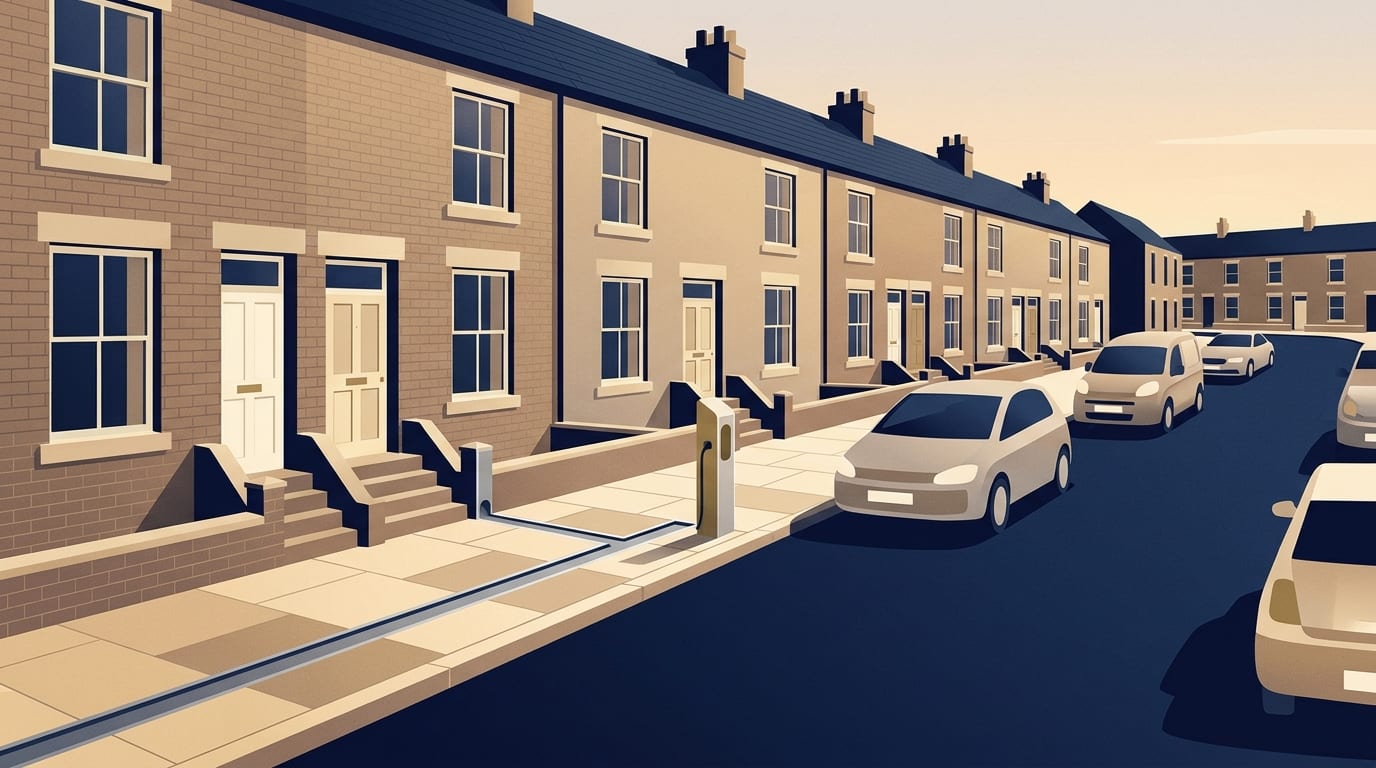
The most common type is a cable channel, sometimes called a gully. These channels are embedded directly into the surface of the pavement. They hold the charging cable securely flat while a vehicle charges. Once you have finished charging, you remove the cable completely so the pavement is clear.
Another option is a permanent under pavement cable. This involves burying a permanent electrical supply beneath the pavement. The cable connects to the kerbside through an above ground interface, such as a removable bollard. When you want to charge, you plug your car into the bollard rather than trailing a cable all the way back to your house. Both methods require digging up the public highway, which is why strict rules apply.
The planning rules and changes from October 2026
The rules in England are changing. From 21 October 2026, a new permitted development right allows for the installation of a cross pavement solution without needing a full planning application.
This permitted development right is subject to specific conditions. If your proposed installation does not meet these conditions, a formal planning application is required. The rights also exclude certain protected sites and properties. If you live in a conservation area, you should check with your local planning authority first before making any plans. The government estimates that this change could save households up to £300 in installation costs.
Who has to give permission for a pavement channel
Even with the new permitted development right, you cannot simply hire a contractor to cut a channel into the pavement outside your house. The pavement does not belong to you, and the local authority needs to ensure it remains safe for pedestrians.
You will need to obtain the right permissions before any work starts on the public highway. Depending on your street, this can involve several different authorities.
Here is who might need to approve your installation:
- The local highway authority must grant approval for any alterations to the pavement and road access.
- The local planning authority must be consulted if your home is in a conservation area or does not meet the permitted development conditions.
- The landowner must give permission if you live on a private or unadopted road.
The specific permissions you need may include section 178 consent under the Highways Act 1980 and section 50 licences under the New Roads and Street Works Act 1991. You should also be aware that installing a charger and a pavement channel does not give you ownership of, or priority over, the parking space outside your home. Disabled parking bays are an exception to this rule, but otherwise, any neighbour can still park there.
What it costs and who pays
When you install an EV charger and a cross pavement solution, you are responsible for the costs. Residents typically pay for the home charge point, including electrician fees, any grid upgrades, and public liability insurance where required. The installation covers the hardware, the labour, the necessary licences and ongoing maintenance.
You may be able to pay for the hardware and licences upfront, or you might find companies that offer them by subscription. The cost of the electrical work itself depends heavily on the power output of the charger and how complex the wiring is in your home.
The table below shows typical home charger installation costs, depending on the specification.
|
Charger type |
Typical installed cost |
|---|---|
|
Standard home EV charger |
£500 to £1,200 |
|
7kW home EV charger |
Around £900 |
These figures are typical 2026 prices, and your local quotes will differ depending on your home and chosen equipment. London and the South East cost noticeably more. A quote is a fixed price, while an estimate is not. Always ask for a fixed quote that includes VAT, all materials, the correct electrical certification, and making good any plaster and decoration disturbed during the installation.
The grant for households with on street parking
If you have on street parking, you can apply for a government grant to help lower the cost of getting an EV charger installed. The maximum grant for homes rose from £350 to £500 per socket on 1 April 2026.
According to the GOV.UK household chargepoint grant page, you can get 75% off the cost of buying and installing a socket, up to a maximum of £500. Residents can apply for one socket per household.
To qualify, you must have the necessary local authority permission for your cross pavement solution. The grant for households with on street parking is currently open for applications until 31 March 2027, so it is worth starting the process early to ensure you secure the funding. Separately, the government has created a £25 million Pavement Channels Grant to help local authorities fund channels for residents without off street parking, which may reduce the upfront cost you face from your council.
Is a cross pavement solution right for you?
A home charger is an investment, so you need to be sure it will actually be useful on your specific street. Cross pavement solutions are most effective where a resident can park on street by their property at least once a week.
If you live on a street where parking is severely limited and you rarely get to park anywhere near your own house, a channel will not be much use to you. A charging cable has a limited length. If someone else is parked outside your house, your cable will not reach your car, and you cannot stretch it across your neighbour's parking space. If you cannot reliably park outside your own home, you may have to rely on other ways to charge, such as workplace chargers or public charging hubs.
What an electrician does during the installation
Installing an EV charger is not a simple DIY task. It requires a registered electrician to design, install and test a new circuit. The charge point and its circuit are classed as notifiable electrical work under Part P of the Building Regulations, which covers electrical safety in homes in England and Wales.
Electricians registered with a government-authorised competent person scheme, such as NICEIC or NAPIT, can self-certify their notifiable work. If an unregistered person does notifiable work, building control must be told before it starts.
Here is what a good quote from an electrician should include:
- Checking your consumer unit and main fuse to ensure they can handle the extra load safely.
- Installing a dedicated circuit with the correct circuit breaker and RCD protection.
- Fitting the charge point securely to your outside wall and wiring it to the new circuit.
- Supplying an Electrical Installation Certificate to prove the work has been tested and is safe.
- Notifying the local authority building control on your behalf to generate a compliance certificate.
The electrician focuses on the electrical safety of your home and the charger itself. They do not usually dig the pavement channel or handle the local authority street works licences. That work is often done by a specialist contractor approved by the council.
Checking your consumer unit and earthing
Before installing a charger, the electrician will inspect your existing electrical setup. They will look at your consumer unit, which is also called a fuse box or fuse board. EV chargers draw a large amount of power for many hours at a time. If your consumer unit is very old, it might not be safe to add a new circuit to it.
The electrician will also check your earthing and bonding. Earthing provides a safe path for a fault current to flow away into the ground, while bonding connects metal pipes to the earth to stop you getting a shock if they become live. If these are missing or undersized, the electrician may need to upgrade them before fitting the charger.
Sometimes, an electrician will recommend an Electrical Installation Condition Report, or EICR, before adding a large new load to an old property. An EICR is a thorough inspection and test of the existing wiring. It will highlight any hidden dangers that could make the new installation unsafe. If the electrician finds that your main supply fuse is too small, you will need to ask your local distribution network operator to upgrade it. You can read more about whether your home needs a bigger supply for an EV charger before you book the job.
Safety devices and electrical protection
Electricity is dangerous, and an EV charger sits outside in the rain while passing high currents into a large metal vehicle. Because of this, the national wiring standard, known as BS 7671 or the Wiring Regulations, demands specific safety devices for the installation.
Your new circuit must have an RCD, or residual current device. This switches off the power instantly if it detects that electricity is leaking to earth, which can mean someone is getting a shock. Modern consumer units often use an RCBO, which combines an RCD with a standard circuit breaker in one single switch.
The electrician may also fit a surge protection device. This protects your home wiring and the sensitive electronics inside your electric car from sudden spikes in voltage, such as those caused by a nearby lightning strike. You should make sure your electrician explains these technical terms and includes the necessary protection in their fixed price quote. It is also wise to know how to compare electrician quotes to spot any hidden extras before work begins.
Paperwork and your consumer rights
When the job is finished, you must receive the right paperwork. A new circuit for an EV charger must be certified with an Electrical Installation Certificate. Because the work is notifiable, you should also receive a Building Regulations compliance certificate shortly afterwards. You should keep both of these documents safely, as you will need them when the property is sold.
Under the Consumer Rights Act 2015, a service must be carried out with reasonable care and skill. If the installation is faulty, you can ask for poor work to be put right at no extra cost. Services arranged at home, by phone or online usually carry a 14-day cooling-off period. This may let you cancel the contract, though it does not automatically apply to urgent repairs you have explicitly asked for. If you have concerns about the standard of the work, you can contact Citizens Advice for guidance based on your own situation.
Common problems to watch out for
Not all electrical installations go smoothly, and it pays to know what poor practice looks like. One common problem is choosing an installer on price alone. Very cheap quotes can leave out essential parts of the job, such as making good the plasterwork or paying the VAT. Making good involves repairing the plaster and paintwork where cables have been routed through your walls.
Another frequent issue is unregistered work. If you hire someone who is not registered with a competent person scheme, you will likely be left with no certificate and no notification to building control. This makes it very difficult to prove the charger is safe or legal.
You should also be wary of paying large cash deposits with no paperwork. A reputable electrician will provide a detailed, written quote and will agree a safe payment schedule with you, often taking payment in stages as the work progresses. Never accept a vague quote, and never let an electrician pressure you into extra work, such as a full house rewire or a new consumer unit, unless they can provide test evidence to prove it is necessary.
Common questions
Can I run a charging cable out of my window?
No, you should not run a charging cable out of a window and across the pavement. It creates a serious trip hazard for pedestrians and may breach the Highways Act 1980. You should use an approved cross pavement solution instead.
Does installing a charger mean I own the parking space?
No, installing a charge point and a pavement channel does not give you any ownership of the parking space outside your home. It also does not give you priority over it, meaning the space is still open to other drivers, except for disabled parking bays.
Will the council pay for my cross pavement channel?
The government has created a grant to help local authorities fund these channels, but residents typically pay for their own home charge point and the associated installation costs. You can apply for a household grant that covers 75% of the socket cost up to £500.
What happens to the cable when I am not charging?
If you have a cable channel embedded in the pavement, you only place the cable inside it while the car is plugged in. Once the vehicle has finished charging, you must remove the cable completely so the pavement is clear.
Your next steps
Getting an EV charger without a driveway takes a bit of planning. Follow these steps to get the process moving safely and legally.
- Check with your local council to see what their current policy is for cross pavement solutions on your street.
- Apply for the necessary highway and planning permissions if a channel or bollard is allowed in your area.
- Get fixed price quotes from registered electricians to install the home charge point and check your consumer unit.
- Apply for the government grant for households with on street parking before the scheme closes on 31 March 2027.
- Arrange for the pavement works and the electrical installation to be completed once you have all the approvals in place.
TopRatedElectricians.co.uk lists local electricians and ranks them using their Google reviews, though we do not employ, vet, certify or guarantee anyone. Once you have spoken to your council and know what is allowed, you can use our directory to find an electrician near you who can safely install your new charge point.
Find a top rated electrician near you
4,987 electricians across the UK, each ranked on their Google rating and the number of reviews behind it. Start with your county: