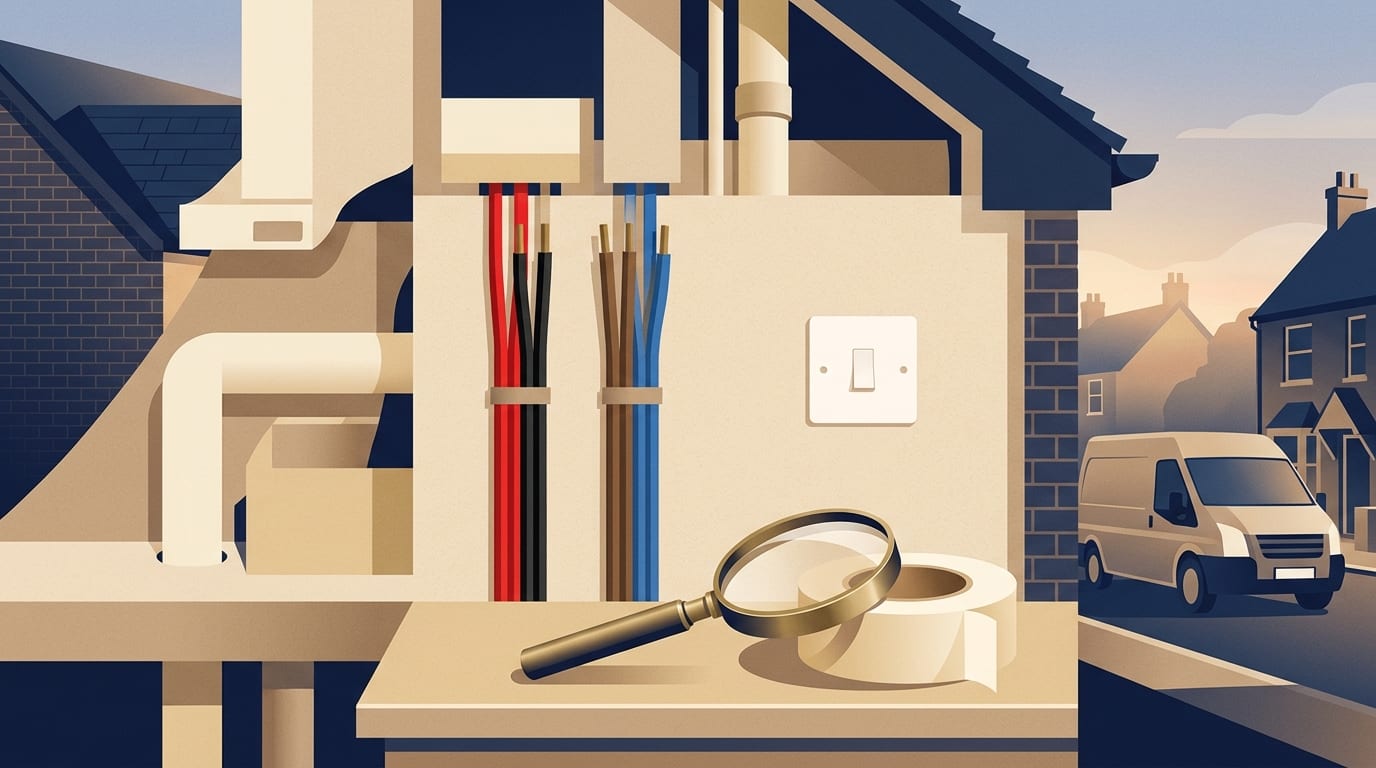
Since the mid 2000s, UK fixed wiring uses brown for the live conductor and blue for the neutral wire. Older installations used red and black, so spotting red and black cable is simply a clue to the age of your electrics rather than proof of a fault. Finding older UK wiring colours does not automatically mean your installation is unsafe, and it is certainly not a reason to panic.
Why wiring colours changed
The UK changed its standard cable colours to match the rest of Europe in a process known as European harmonisation. This change was introduced through Amendment 2 of 2004 to the national wiring standard, which is BS 7671. You will often hear electricians refer to this standard simply as the Wiring Regulations.
The transition did not happen overnight. For work commencing on site after 31 March 2004, electricians could use either the new harmonised colours or the old colours. The only rule during this transition period was that they could not use both sets of colours on the same site.
This grace period lasted for two years. For any installation work starting on site after 31 March 2006, the rules stated that electricians were required to comply with the harmonised cable colours. From that date, they must not use the old colours for new fixed wiring.
The new colours were actually already in common use before 2004. Electricians were very familiar with them because brown and blue were already the standard colours found inside appliance flexes and lighting pendants.
Single phase colours in most homes
Most standard residential properties in the UK run on a single-phase electricity supply. In a modern single-phase circuit, the phase conductor is brown and the neutral conductor is blue. The phase conductor is the wire that carries the live current, which is why it is commonly called the live wire.
In older installations, the phase conductor was red and the neutral conductor was black. The protective conductor, which you likely know as the earth wire, did not change its colours during the 2004 harmonisation. It remains green and yellow.
The table below shows the old and new wiring colours for a single-phase electrical installation side by side.
|
Conductor purpose |
Old UK colour |
New UK colour |
|---|---|---|
|
Phase (live) |
Red |
Brown |
|
Neutral |
Black |
Blue |
|
Earth (protective) |
Green and yellow |
Green and yellow |
You can also spot these colours on the items you plug in every day. The neutral wire on an appliance flex is blue.
Three phase colours
Some larger homes, blocks of flats and commercial buildings use a three-phase electricity supply to handle heavier power demands. A three-phase system has three separate live conductors alongside a neutral and an earth. The harmonisation rules also changed the colours for these installations.
In older three-phase installations, the three live phases were coloured red, yellow and blue. The neutral conductor was black. This meant that the colour blue used to mean a live phase, whereas today it means neutral.
Under the new harmonised rules, the three live phases are marked as phase 1, phase 2 and phase 3. Phase 1 is brown, phase 2 is black and phase 3 is grey. The neutral conductor in a new three-phase circuit is blue.
The table below shows the old and new wiring colours for a three-phase installation.
|
Conductor purpose |
Old UK colour |
New UK colour |
|---|---|---|
|
Phase 1 (L1) |
Red |
Brown |
|
Phase 2 (L2) |
Yellow |
Black |
|
Phase 3 (L3) |
Blue |
Grey |
|
Neutral |
Black |
Blue |
As with single-phase systems, the protective earth conductor remains green and yellow.
What red and black wiring tells you about age
Spotting red and black single-phase cables tells you something about when your property was wired, but it is not an exact science. Red and black were used for the line and neutral from the 1950s right up until the changeover period between 2004 and 2006.
This means a red and black cable could be from a modern extension built in 2003, or it could be original wiring from 1960. You cannot tell the exact year simply by looking at the red and black cores.
Electrical testing alone is also insufficient to give an installation an exact age. Properties are rarely wired once and never touched again. Installations often combine components of entirely different ages, with new sockets or circuits added decades after the original wiring was put in.
Other age clues in an electrical installation
While red and black cables give a wide date range, there are other visual clues that electricians use to estimate the age of an installation. The sleeving on the protective earth conductor is a strong indicator. Green sleeving was used for protective conductors from 1966 to 1977. Since 1978, only green and yellow sleeving has been used.
Flexible cords supply power to items like pendant lights and appliances. These had red, black and green cores in the 1950s up to 1971. From 1971 onwards, flexible cords switched to using brown, blue and green and yellow cores.
The material covering the fixed wiring is another major clue. PVC insulation was introduced in the early 1950s.
Before PVC became standard, rubber insulated cable was widely used until the early 1950s. This older cable often has a dull black sheath that can become hardened or brittle over time.
Another early material is fabric covered cable, which usually has a braided outer layer that is black or dull red. If your home has fabric covered cable, you should be aware that some older fabric covered cables may contain asbestos. Do not disturb it, and ask a registered electrician for advice.
Why old and new colours in one home need care
Many homes have had an extension, a loft conversion or a new circuit added since the rules changed in 2006. This means the property will have a mix of the old red and black wiring and the new brown and blue wiring. This is perfectly normal and legal.
When an electrician makes an alteration or addition to a single-phase installation, they do not need to mark the interface between the old and new cables, provided the old red and black cables and the new brown and blue cables are correctly identified.
For alterations or additions to two-phase or three-phase installations wired in the old colours, unambiguous identification is required. The neutral conductors must be marked with an N, and the phase conductors must be marked L1, L2 and L3 on both the old and the new cables.
Whenever old and new colours are joined in one installation, a caution notice is fixed on or near the consumer unit. The consumer unit is the technical name for your fuse box or fuse board.
The notice reads: "This installation has wiring colours to two versions of BS 7671. Great care should be taken before undertaking extension, alteration or repair that all conductors are correctly identified." If you see this sticker, it shows that old and new wiring colours have been joined in your installation. It is not a warning of a fault.
Does old wiring mean a rewire is needed?
Finding old wiring colours does not automatically mean your house needs to be rewired. Cables can last for many decades if they are not overloaded, disturbed or damaged. However, there are physical limits to older materials, and you should look out for warning signs your house needs rewiring.
Rubber insulated cable, widely used until the early 1950s, can become hardened or brittle with age. You should always use a registered electrician to carry out any work, and never attempt to check the condition of hidden cables yourself.
There are visible signs that older electrics may be struggling. You should seek professional advice if you notice any of the following:
- Round-pin sockets still in use
- Braided flex on ceiling lights
- Sockets mounted directly in skirting boards
- Burn marks on sockets or switches
- Crackling sounds from electrical fittings
- Excessive heat coming from any switch or plug
If you notice any of these, keep away from the damaged equipment and call an electrician. As a general rule, electrics over 50 years old should be checked and updated. You can read more about safety for older and vulnerable people to help protect yourself or family members living in older properties.
When to call a registered electrician
You cannot judge the safety of electrical work just by looking at the colours of the wires. The only way to know if an older installation is safe for continued use is to have it tested by a registered electrician.
This thorough check is called an Electrical Installation Condition Report, or EICR. During an EICR, the electrician tests the circuits for hidden degradation and checks that the earthing and bonding are sufficient. They will also inspect the consumer unit to see if it provides modern protections like an RCD or circuit breaker.
For owner-occupied homes, it is a recommendation to have a periodic inspection at least every 10 years. For tenanted properties, the recommended periodic inspection is every 5 years or at each change of occupancy, whichever is sooner. Landlords in England face substantial penalties if they fail to meet their legal duties regarding electrical safety.
An EICR is usually quoted as a fixed price based on the size of the property, the number of circuits, the ease of access and the exact specification of the test. London and the South East cost noticeably more than other regions.
Be cautious if you are offered a very cheap inspection. Sometimes, heavily discounted tests are used to sell long lists of remedial work. Advisory items on an EICR might be presented unfairly as outright failures to push you into buying a new consumer unit. If you are told a full rewire or a new consumer unit is compulsory, ask to see the test evidence. If you are unsure, it is always sensible to get a second opinion.
Rules and protections for electrical work
If your older wiring does need to be updated or replaced, you need to understand how the trade works and what paperwork to expect. Electrical work in homes in England and Wales is covered by Part P of the Building Regulations. Scotland has its own building standards system and Northern Ireland differs, so rules vary depending on where you live.
When you hire an electrician who is registered with a government-authorised competent person scheme, such as NICEIC or NAPIT, they can self-certify that their notifiable work meets the building regulations. If an unregistered person does notifiable work, local building control must be told before the job even starts.
When you ask for a quote for a defined job, you need to know exactly what you are paying for. A proper written quote should clearly state whether it includes:
- The current rate of VAT
- All necessary materials and parts
- The correct electrical certification upon completion
- Making good any damaged plaster and decoration
An estimate is not a fixed price and can increase. Small jobs and fault finding are usually charged by the hour, often with a call-out fee or minimum charge that covers the first hour. Out-of-hours work carries a premium.
After notifiable work is completed, you should receive an Electrical Installation Certificate and a Building Regulations compliance certificate. For smaller jobs, you should receive a Minor Works Certificate. You must keep these documents safe, as you will need them when the property is sold. If you are unsure about the rules, you can read more about electrical certificates and part p.
Under the Consumer Rights Act 2015, any electrical service must be carried out with reasonable care and skill. If the work is poor, you can ask for it to be put right at no extra cost. Services arranged at home, by phone or online usually carry a 14-day cooling-off period, though this does not automatically apply to urgent repairs you have specifically asked for.
Common questions
Is the red wire live or neutral?
In older UK single-phase fixed wiring, the red wire is the phase conductor, which means it is the live wire. The black wire is the neutral. Never rely on colour alone, because installations are often altered over the years, and never touch or test wires yourself. Leave that to a registered electrician.
Can you mix old and new wiring colours?
Yes, an electrician can connect new brown and blue cables to existing red and black cables when extending a circuit, provided the cables are correctly identified. They will fix a caution notice to your consumer unit to warn anyone working on the electrics that two different versions of the wiring rules are present in the house.
Is it illegal to have red and black wiring?
No, it is not illegal to have red and black wiring in your home. The new colours could be used for work starting on site after 31 March 2004 and became required for work starting on site after 31 March 2006. You do not have to rip out old cables just because they are red and black, provided they pass a proper safety test.
Do I need a full rewire if I have red and black cables?
Red and black cables alone do not mean you need a full rewire. Red and black cables were used until 2004 to 2006, so many installations still contain them. Only a test and inspection by a registered electrician can show whether any work is needed.
How can you tell which wire is live if the colours are faded?
You should never attempt to guess which wire is live or touch exposed wiring. Only a registered electrician has the correct equipment and training to safely test and identify conductors. Never remove covers or open a consumer unit yourself.
Next steps
If you have found old wiring colours in your home and want to know if the installation is still safe, you should arrange for a professional inspection.
- Check that any electrician you contact is registered with a government-authorised competent person scheme.
- Ask them for a fixed price quote for an Electrical Installation Condition Report.
- Confirm whether their quote includes VAT.
- Ask how long the test will take and whether the power will need to be off for the whole duration.
- Wait for the written EICR results before agreeing to any remedial work or upgrades.
Electricity is dangerous, and guessing the condition of older cables is never worth the risk. A proper test will give you the information you need to make a sensible decision about your home. This site lists electricians but does not employ or vet them, so check the registration of anyone you choose. When you are ready to book an inspection, you can easily find an electrician near you to test your wiring safely.
Find a top rated electrician near you
4,987 electricians across the UK, each ranked on their Google rating and the number of reviews behind it. Start with your county: