Cables are buried in walls and floors, and drilling into one is a very common DIY error. To avoid a serious accident when hanging a shelf, TV bracket or radiator, you need to know where wiring is most likely to run and take extra care around your sockets and switches.
Why hidden cables are a real risk
Hitting hidden cables is a common error when doing jobs around the house. When you drill into a wall, the drill bit can easily pierce the plastic insulation surrounding an electrical wire. If the drill bit touches the live copper wire inside, the metal body of the drill can become live, sending a dangerous electrical current through your hands and body.
Electrical Safety First warns against drilling, nailing or screwing close to cables in the wall. Doing so can cause serious harm. Electrical Safety First notes that any electrical work should be left to competent professionals.
Even a simple task like putting up a picture hook or a curtain rail carries a risk if you do not know what is behind the plaster.
How cables usually run through walls
When a house is wired, electricians follow the national wiring standard, known as BS 7671 or the Wiring Regulations. During the first fix stage of a wiring job, the electrician runs all the raw cables through the walls, floors and ceilings. During the second fix stage, after the plastering is finished, the accessories like sockets and switches are connected.
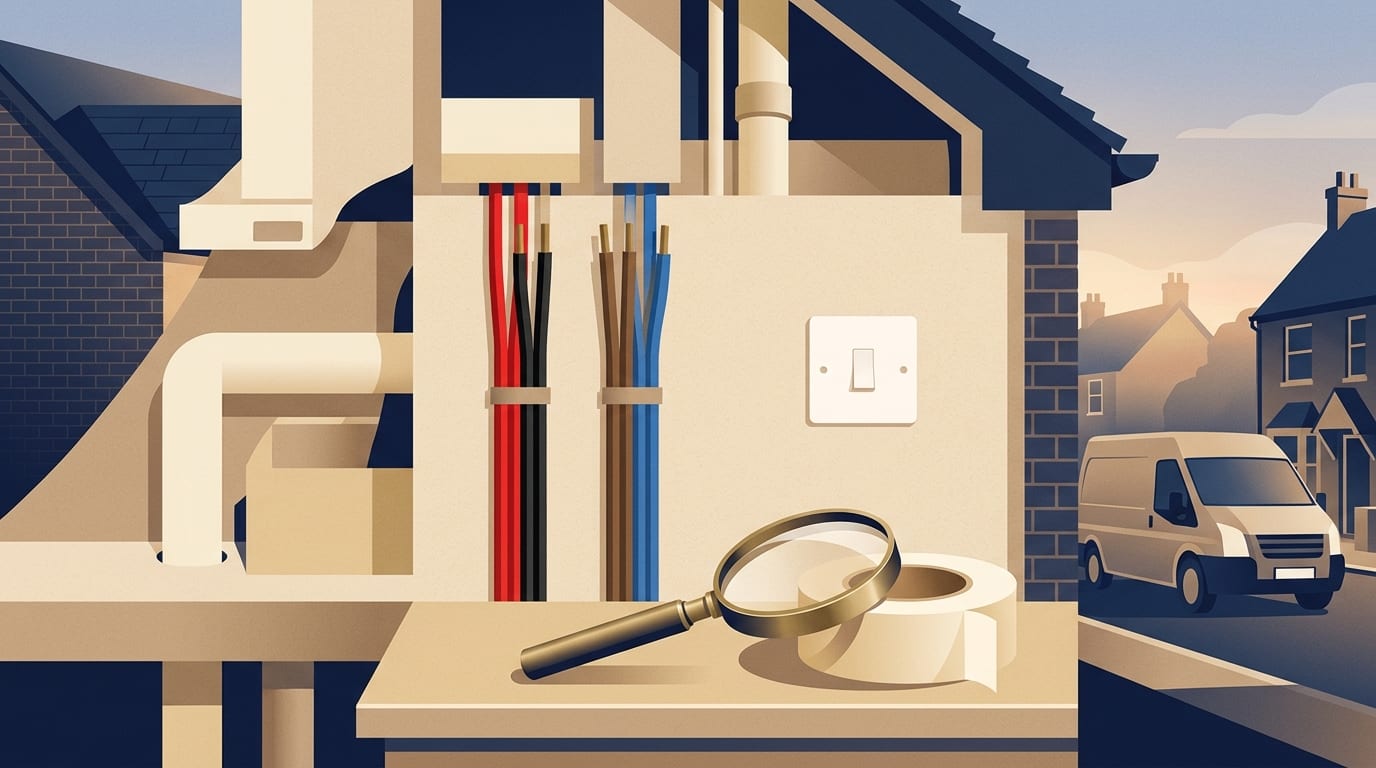
Cables buried in walls are installed either horizontally or vertically from accessories such as sockets and switches. Because of this layout, you should always assume there is a cable running directly up, down, left or right from any electrical fitting you can see on the wall.
You must take extra care when working above, below and beside sockets and switches. You should also be very careful near the corners of a room and up near the ceiling, as cables are frequently routed through these spaces before dropping down to a fitting.
What a cable detector can and cannot tell you
A good quality cable detector can help you locate buried cables before you start work. It is sensible to check for live wires before drilling into any surface.
However, a detector is not a guarantee, so if you are unsure, ask a registered competent electrician.
If you are unsure, a qualified electrician can help safely detect any live electricity lines before you begin your project. Electricians have the experience to interpret the layout of a room and the professional testing equipment to trace circuits accurately.
Where hidden cables are more likely
Because cables run horizontally and vertically, certain areas of your walls are much more likely to hide live wiring. You should always pause and check carefully if your planned hole is in one of these places.
- Directly above or below any plug socket, light switch or fused spur.
- Directly to the left or right of any electrical accessory.
- High up near the ceiling where cables run horizontally between rooms.
- Close to the internal or external corners of walls where wiring changes direction.
- Around the consumer unit (also called a fuse box or fuse board), where all the circuits in the house converge.
If you are unsure, ask a professional
Electricity is dangerous, and guessing where a cable might be is never worth the risk. Electrical Safety First advises that if you are not sure, do not DIY. You should never follow online DIY advice if you are not 100% confident it has been provided by a fully qualified and competent person.
If you are unsure about potential electrical risks, you should seek advice from a registered competent electrician. You can check an electrician is registered by looking for their details on the websites of government-authorised competent person schemes, such as NICEIC (run by Certsure) or NAPIT. Registration is one way to check an electrician, but it does not guarantee any particular job.
Please note that TopRatedElectricians.co.uk is a directory that lists local electricians and ranks them by their customer reviews to help you compare them. It does not employ, vet, certify or guarantee anyone.
When you arrange for a professional to visit your home, you have rights under the Consumer Rights Act 2015. This law says that a service must be carried out with reasonable care and skill, and you can ask for poor work to be put right at no extra cost. Services arranged at home, by phone or online usually carry a 14-day cooling-off period. However, this does not automatically apply to urgent repairs you have specifically asked the electrician to carry out immediately.
What to do if you hit a cable
If your drill hits something and you see sparks, hear a pop, or feel a shock, stop immediately. Do not touch the drill, the cable, or the wall if there was a shock or sparks. Keep everyone, including children and pets, away from the area entirely.
If someone has received a shock and is hurt, call 999 immediately. If the person is unconscious, you must dial 999 right away. The Electrical Safety First first aid guidance states clearly that you must never touch the person receiving the electric shock while they are still in contact with the electricity source. Doing so could mean you receive a severe shock yourself.
Even if the person is conscious and seems completely well, monitor them closely. The effects of a shock may not be obvious right away. Electric shocks can cause internal injuries such as deep burns, heart rhythm problems and broken bones. Always seek medical advice if a shock has occurred.
Checking after a mishap
If you damage a cable, the circuit must be checked and repaired by a registered electrician. You should not use that circuit at all until a professional has made it safe. Do not attempt to dig the cable out of the plaster, wrap it in tape, or join the broken ends together.
When you hire an electrician to fix the damage, they will usually charge by the hour for fault finding and small repairs. There is often a call-out fee or a minimum charge that covers the first hour of their time. Out-of-hours work, such as calling an emergency electrician late at night or on a Sunday, carries a premium rate.
When you ask for pricing, make sure you understand exactly what is included. A quote is a fixed price for a defined job, whereas an estimate is not a fixed price. Ask if the quoted price includes VAT, the materials needed to fix the wire, and whether it covers making good. Making good means filling the plaster and fixing the decoration where the wall had to be cut open.
Be cautious of common problems like vague quotes or being asked for large cash deposits with no paperwork. For a small repair, the electrician should provide a clear invoice and a Minor Works Certificate for the work.
The paperwork required by law depends on the exact repair. The Planning Portal states that most repairs, replacements and maintenance jobs are not notifiable under the Building Regulations. Part P of the Building Regulations covers electrical work in homes in England and Wales. Scotland has its own building standards system and Northern Ireland differs.
The table below outlines how the Planning Portal categorises different electrical jobs.
|
Type of electrical work |
Building Regulations status |
|---|---|
|
Most repairs, replacements and maintenance jobs |
Not notifiable |
|
Complete new circuit |
Notifiable |
|
New consumer unit |
Notifiable |
|
Alterations to existing circuits in special locations |
Notifiable |
The table follows the Planning Portal categories. In England, special locations mean the spaces around baths and showers, while in Wales they also include kitchens and outdoors. Electricians registered with a scheme like NICEIC or NAPIT can self-certify notifiable work. If an unregistered person does notifiable work, building control must be told before it starts.
Rented homes and your landlord
If you live in a rented property and accidentally drill into a hidden cable, you must tell your landlord about the damage immediately. Do not try to hide the mistake or hire an unregistered person to do a quick, cheap fix, as poorly repaired cables are a severe fire hazard.
Landlords have legal duties to have the electrical installations in their properties inspected at least every five years. This inspection produces an Electrical Installation Condition Report (EICR). There are nation specific rules and substantial penalties in England for landlords who fail to do this. For owner-occupiers, periodic inspection is a recommendation, not a legal duty.
Your landlord can then arrange for a registered electrician to inspect and repair the damage. If they refuse to make the property safe, you might need to read up on what to do when a landlord will not fix electrical faults.
Jobs best left to an electrician
Some tasks around the home carry a much higher risk of hitting hidden cables than others. If your project involves any of the following, it is safer to hire a registered competent electrician from the start.
- Wall mounting heavy items, such as large televisions, heavy radiators or kitchen cabinets, directly above or near sockets.
- Chasing channels into the plaster to hide wires for a new media wall.
- Moving existing sockets or light switches to a new location on the wall.
- Any job that involves cutting deep into the wall structure or removing old plaster.
For these tasks, use a registered competent electrician, who can manage the risks and issue the right certificate for any notifiable work.
If you are doing larger renovations, you might also be looking into hiding tv cables in the wall safely, which an electrician can plan and execute to the correct standard.
Common questions
Can I use a stud finder to find cables?
Electrical Safety First refers to a good quality cable detector, not a stud finder. Even a cable detector is not a guarantee, so if you are unsure, ask a registered competent electrician.
Do cables always run in straight lines?
Cables buried in walls are installed either horizontally or vertically from sockets and switches. However, you cannot know how a particular wall was wired, so extra caution is needed. If you are unsure, ask a registered competent electrician.
Will my consumer unit trip if I drill into a cable?
You should never rely on a consumer unit as a safety measure when drilling. Stop and keep away if you see sparks or feel a shock, and do not use the circuit until a registered electrician has checked it.
How much does it cost to fix a drilled cable?
Small jobs and fault finding are usually charged by the hour, often with a call-out fee or minimum charge that covers the first hour. The total cost will depend on the extent of the damage and the access. London and the South East cost noticeably more.
Is a full rewire compulsory if I damage one wire?
Not automatically. An electrician decides what work is needed after testing the circuit. Be wary of very cheap inspections used to sell long lists of remedial work, or being told a full rewire or a new consumer unit is compulsory with no test evidence to back it up. Advisory items are sometimes falsely presented as failures, so getting a second opinion is sensible if you are suspicious.
Next steps
Before you pick up a drill to hang anything on your walls, make sure you have assessed the area properly.
- Look at the positions of all sockets, switches and fused spurs in the room.
- Visualise the vertical and horizontal paths where cables are most likely to run.
- Use a good quality cable detector to help check the area you plan to drill, remembering that it is not a guarantee.
- Ask a registered competent electrician if you get a positive reading or feel unsure.
- Remember that any electrical repair work should be left to competent professionals.
If you need professional help to locate cables safely, or if you need a damaged circuit repaired, your next step is to find an electrician near you.
Find a top rated electrician near you
4,987 electricians across the UK, each ranked on their Google rating and the number of reviews behind it. Start with your county: