
Immersion Heater Not Working and What a Repair Costs
TopRatedElectricians.co.uk · 7 October 2026
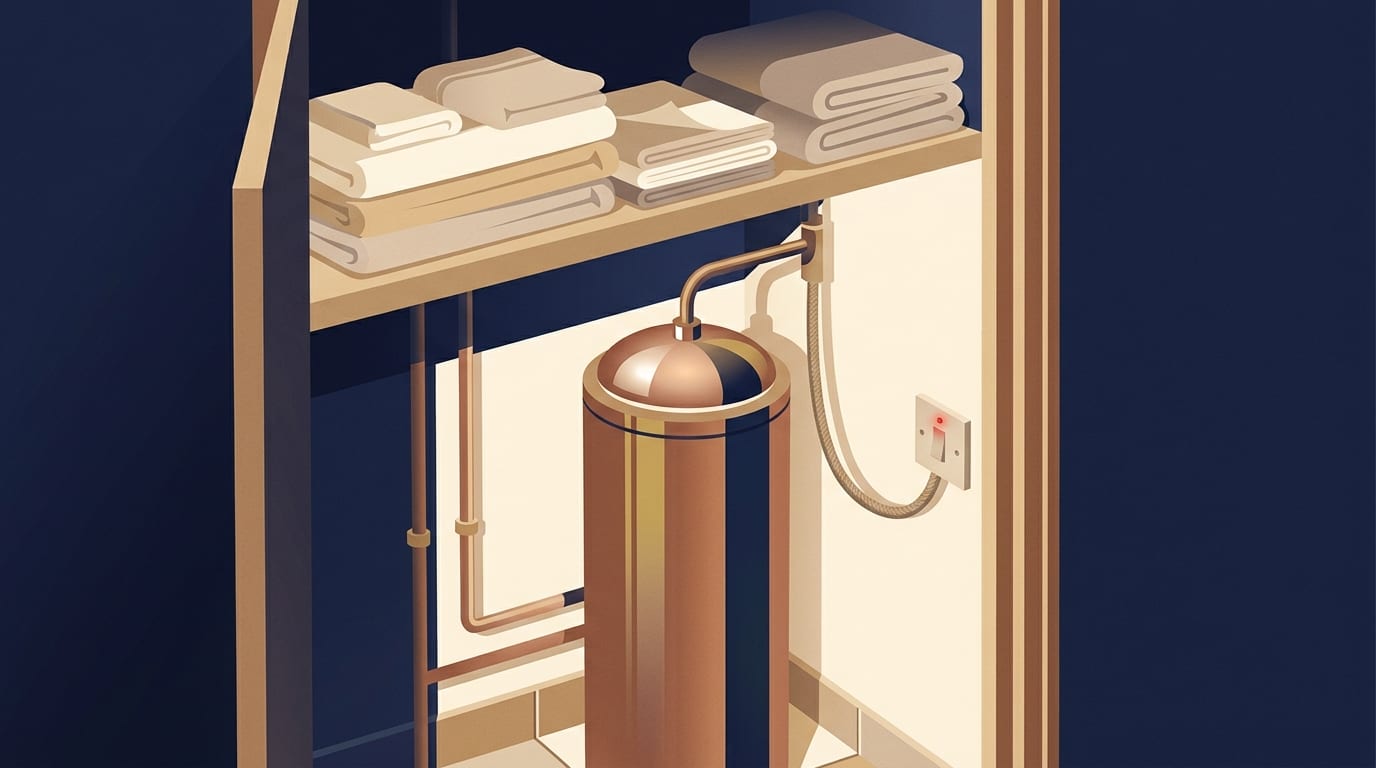
If you have no hot water, the most common reasons are a failed heating element or a broken thermostat. A straightforward element replacement typically costs £120 to £260 in 2026, while replacing just the thermostat is cheaper. The replacement parts are inexpensive, so your final bill depends mostly on how long it takes a professional to drain the cylinder and access the heater.
What an immersion heater does
An immersion heater is an electric element sitting inside your hot water cylinder. It works just like a large kettle to heat the water around it. The heater is controlled by a thermostat that measures the water temperature and cuts the power when it gets hot enough. Many homes rely entirely on a gas boiler for hot water and keep the immersion heater turned off as a backup.
If your home has storage heaters, you will probably have a hot water cylinder with two immersion heaters. The main immersion heater at the bottom heats all the water in the cylinder. It does the heavy lifting overnight when electricity is cheaper, storing the hot water for the day ahead. If it has a timer, this should be set to come on during off-peak times.
The second heater sits higher up the cylinder and heats only the water near the top. This provides a quick top up if you run out of hot water during the day. This one usually has its own controls labelled boost. On a time-of-use tariff, the boost heater uses the more expensive peak-rate electricity, so it is best used only when you really need it.
Common reasons an immersion heater stops working
When your water runs cold, the problem usually falls into one of a few categories. These are the most common faults professionals find when diagnosing a hot water issue.
- A failed heating element that has burned out and needs to be replaced.
- A faulty thermostat that either stops the water getting hot or trips the safety cut-out.
- The main switch or fused spur on the wall being turned off by mistake.
- A tripped circuit breaker or residual current device at your consumer unit.
- A timer that is set to the wrong mode or shows the wrong clock time.
- An older Economy 7 radio teleswitch meter that has stopped switching because the radio signal is being turned off.
Checks you can safely make first
Before you call a professional, there are a few safe visual checks you can do yourself. Check that the immersion heater switch on the wall is turned on. If you have a timer, check it is in timer mode. A switch set to 1 means the heater is always on, and a switch set to 0 means it is always off. Check that the clock dial shows the current time, as a power cut can put the clock out of sync.
You can also check your consumer unit, which is often called a fuse box or fuse board, to see if a switch has tripped. If you find a tripped switch, you can read our guide on why your electricity keeps tripping to find out what to do next.
Electricity and water are a dangerous combination, so you must never remove the immersion heater cover yourself. Never press the thermostat cut-out button under the cover, test the element, adjust the cylinder thermostat or try to drain the cylinder. If a safety cut-out keeps tripping, you need a professional to find out why. Keep well away from any damaged equipment.
If you smell burning, turn off the power at the main switch only if it is safe to reach. Call 105 for a power cut, or call 999 for a fire or serious electric shock. If you rent your home, report the fault to your landlord immediately so they can arrange a repair.
Electrician, plumber or heating engineer?
Replacing an immersion heater is a hot water cylinder job with an electrical connection. In practice, it is typically a plumber or heating engineer who does it. This is because the bulk of the work involves isolating the water supply, draining enough water from the cylinder, drawing the old element out and refilling the system. The electrical side of a straightforward swap is a simple fused spur connection rather than complex wiring.
An electrician is the right call when the fault is on the supply side. This includes a dead fused spur, a tripping residual current device, often known as an RCD, or a timer that is not switching. Many electricians handle both the plumbing and electrical sides of the job.
In England, replacing an immersion element on its existing circuit is not a notifiable job. This means building control does not need to be told. However, if you are having a completely new circuit installed for an immersion heater, this is notifiable work in England and Wales. Alterations to existing circuits are also notifiable in special locations. In England, special locations are the spaces around baths and showers. In Wales, special locations include kitchens and outdoors.
The Planning Portal advises that electrical installation work in homes in England and Wales must comply with the building regulations, and that all electrical work should follow BS 7671, the wiring regulations. It is best to use an installer registered with a competent person scheme who can self-certify the work. If an unregistered person does notifiable work, building control must be notified before the work starts.
How much does an immersion heater repair cost?
The final cost depends on the parts required and how long the job takes. The table below shows typical prices for common repairs.
|
Job |
Typical price |
|---|---|
|
Diagnostic visit covering the first hour |
£60 to £120 |
|
Thermostat only |
£60 to £100 |
|
Single element supplied and fitted |
£120 to £260 |
|
Twin element supplied and fitted |
£200 to £320 |
|
Element and thermostat together |
£180 to £320 |
|
New vented copper cylinder supplied and fitted |
£500 to £1,200 |
These are typical published prices for 2026, and local quotes will differ depending on where you live. Prices in London and the South East are noticeably higher. Quotes may or may not include VAT, materials, and making good any decoration, so you should always check.
The replacement parts are cheap. An element costs about £20 to £60 as a part. Standard copper elements cost about £20 to £30, incoloy elements cost £25 to £35, and long-life titanium elements cost £30 to £40. A new thermostat on its own costs £10 to £25 for the part. In most cases, a failed element is swapped for a new one rather than repaired.
Labour makes up the rest of the bill. A diagnostic visit often comes with a minimum charge of £60 to £120 that covers the first hour. This is usually enough time to test the circuit and confirm if the element or thermostat has failed. A thermostat change needs no draining, takes under 30 minutes and is usually charged as a minimum call-out fee or a fixed £60 to £100.
A straightforward element replacement means isolating the supply, draining the cylinder, removing the old element, fitting the new one, refilling, rewiring and testing. On a healthy cylinder, this takes about an hour and the labour is typically £100 to £150. If the cylinder is boxed in and hard to reach, or the old element has seized in place, labour costs can rise to £150 to £230. If you need an emergency call-out during evenings or weekends, the out-of-hours work typically costs 1.5 to 2 times the standard rate.
When a new cylinder makes more sense
Sometimes an immersion heater repair turns into a larger job. If an element is heavily seized in an older cylinder, applying too much force to remove it can tear the copper. A seized element can turn a one-hour job into a half day.
If your cylinder is heavily corroded, weeping water at the element boss, or the element has sheared off, replacing the whole cylinder is the honest recommendation. The element boss is the threaded metal ring where the heater screws into the tank, and water weeping from it can be a sign that the cylinder itself is failing. A new vented copper hot water cylinder supplied and fitted typically costs £500 to £1,200.
Unvented cylinders need the right installer
Unvented hot water cylinders operate under high pressure. They do not use a cold water tank in the loft, and they cost more to replace than vented copper cylinders. The safety and performance of an unvented hot water system depends on the choice of system and safety devices, and on correct installation.
Approved Document G of the building regulations covers these systems in England. It states that building owners and occupiers should choose installers with the necessary skills. Installing an unvented system is notifiable building work. It must be notified to the building control body before work starts, unless the installer is registered with a competent person scheme for installing unvented hot water systems.
Installers can also show their competence by holding a current registered operative skills certification card for unvented hot water systems, often called a G3 qualification. Before anyone works on a pressurised cylinder, ask to see this card or proof that they are registered with a competent person scheme for unvented hot water systems.
Running costs and using the timer
It can be very expensive to use an immersion heater, so you should make sure it is only on when you need it. The energy price cap is the maximum a supplier can charge for a unit of energy and the standing charge on standard variable tariffs. It does not limit your total bill, and Ofgem sets the price cap level every three months.
At the July to September 2026 price cap unit rate of 26.11p per kWh, a standard 3kW heater costs about 78p an hour to run. If it is on for two hours a day, that is about £11 a week, £47 a month or £570 a year. A larger 6kW heater costs about £1.57 an hour, or £22 a week at two hours a day. Your own tariff may differ from these capped rates.
If you have an off-peak tariff like Economy 7, you should set the timer to heat the water during the cheaper overnight hours. Citizens Advice recommends making sure your hot water cylinder is well insulated and avoiding the boost controls, which use peak rate electricity.
Some older Economy 7 and Economy 10 meters use radio teleswitch technology. Since 30 June 2025 the signal that supports these RTS meters has started to be switched off. Meters that use it will stop working properly, and your electric heating and hot water could stop working entirely if the meter is not replaced. Your supplier should upgrade an RTS meter to a smart meter for free, so contact your energy supplier if you think you have one.
If you are a landlord, you have legal duties regarding water safety. HSE guidance for landlords states that temperature is the most reliable way of keeping the risk of legionella low. Control measures include setting the temperature of the hot water cylinder to ensure water is stored at 60°C. Health and safety law does not require landlords to obtain a legionella test certificate. The HSE advice is to keep hot water hot, cold water cold and keep it moving.
Your consumer rights and protections
When you hire someone to repair your hot water, you are protected by the Consumer Rights Act 2015. This law states that any service must be carried out with reasonable care and skill. If an installer fits an element poorly and it leaks, you can ask for the poor work to be put right at no extra cost.
When you arrange a service at home, by phone or online, you usually have a 14-day cooling-off period. However, this does not automatically apply to urgent repairs that you have specifically asked a professional to carry out.
Be wary of large cash deposits asked for upfront, and always make sure you receive proper paperwork for the work done. Unregistered work often comes with no certificate and no notification, which causes problems when you come to sell the property. A professional should never push you into unnecessary work, such as claiming a full rewire or a new consumer unit is compulsory without showing you test evidence. You can find official guidance on your specific situation by contacting Citizens Advice.
Common questions
What is an immersion heater?
An immersion heater is an electric heating element sitting inside a hot water cylinder. It is controlled by a thermostat and acts like a large kettle to heat the water for your taps and showers.
How long should an immersion heater be on for?
Citizens Advice suggests setting the main immersion heater's timer to come on for an hour or two before the end of the off-peak period, which should give you enough hot water for the day, although you can set it for longer if you need to. Once the water reaches the set temperature, the thermostat cuts the power.
Is there an immersion heater reset button?
The thermostat under the immersion heater cover has a safety cut-out switch that trips if the water gets dangerously hot. You should never remove the cover to press this button yourself. A cut-out that keeps tripping means something is wrong, and a professional needs to find out why.
How much does an immersion heater cost to run?
A standard 3kW element costs about 78p an hour to run at the July to September 2026 price cap rate. If you run it for two hours a day, it costs about £11 a week. Using an off-peak timer can reduce this cost significantly.
Can an immersion heater element be repaired?
When an element stops heating the water, it has usually burned out and failed completely. In most cases the element is swapped for a new one rather than repaired, because the replacement parts are very cheap.
Next steps before you book
When you are ready to book a repair, you should ask a few clear questions to make sure you know exactly what you are paying for. A quote is a fixed price that should not change unless the scope of the work changes. An estimate is just a rough guess and can increase.
Check these points before you agree to any work.
- Does the price include draining and refilling the cylinder?
- Which type of element will be fitted, and is it copper or titanium?
- Will the thermostat be replaced at the same time?
- What happens to the quoted price if the old element is seized?
- Does the final price include VAT and making good?
- What is the out-of-hours rate if this is an emergency call-out?
- Will you supply an invoice and a receipt for the work?
Fixing your hot water does not have to be stressful when you know what to expect and what questions to ask. When you are ready to get quotes, knowing how to choose a local electrician will help you find a professional you can trust. You can then find an electrician near you to get your system working safely again.
Related Guides
Bathroom Extractor Fan Installation Cost and What the Rules Say
What it typically costs to replace or fit a bathroom extractor fan in 2026, which fan suits your room, the ventilation and electrical rules that apply and what to do when a fan stops working.
Electric Cooker and Induction Hob Installation Costs
What it typically costs in 2026 to fit an electric cooker, built-in oven or induction hob, when you need a new cooker circuit, whether a hob can be plugged in and the rules that apply.
Replacing Old Storage Heaters and What It Costs
When it is worth replacing old storage heaters, what modern high heat retention models cost to buy and fit in 2026, the tariff and meter checks to make and the asbestos risk in very old units.