
Electric Cooker and Induction Hob Installation Costs
TopRatedElectricians.co.uk · 7 October 2026
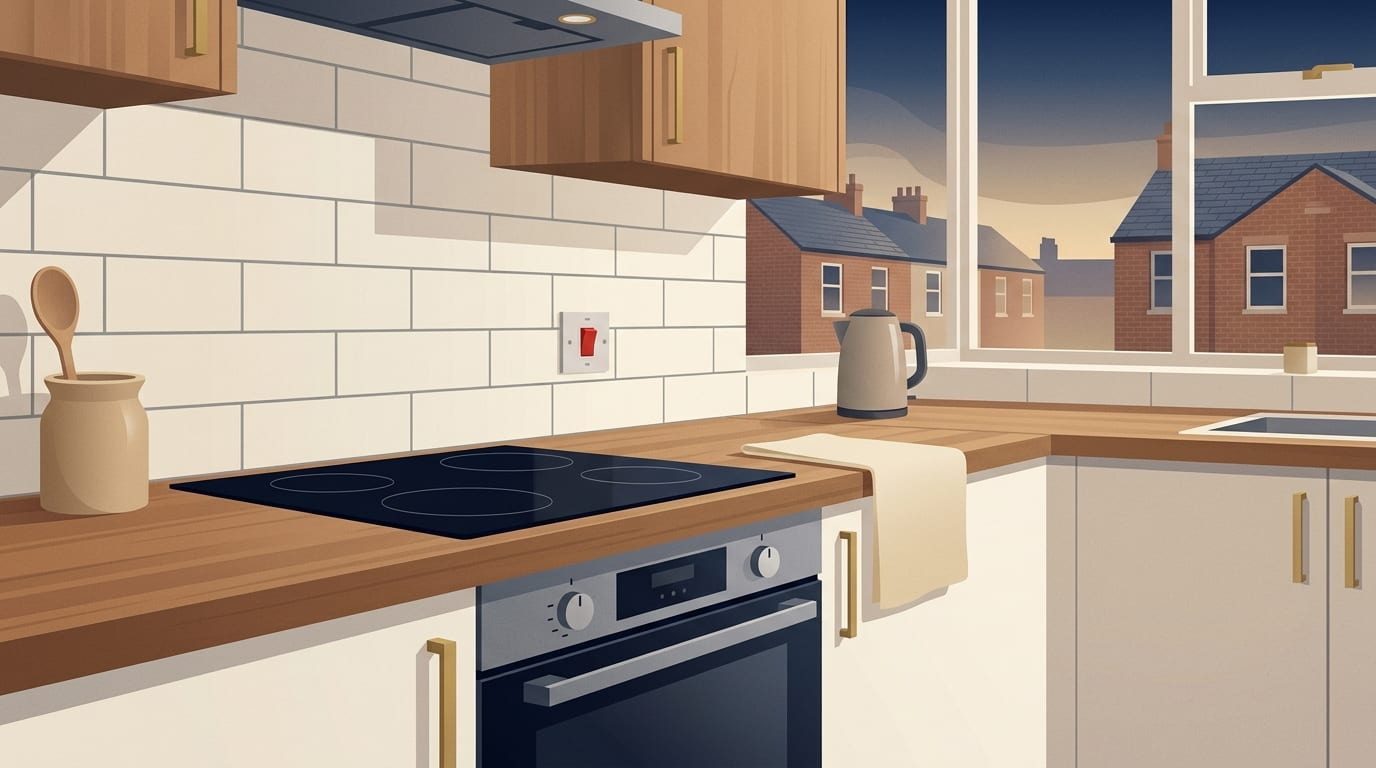
Fitting labour for an electric cooker typically costs £80 to £250 in 2026, with a standard swap averaging around £150. Prices are noticeably higher in London and the South East, and the total cost will rise significantly if your kitchen needs a brand new cooker circuit.
When you buy a freestanding electric cooker or a built-in oven, the installation cost depends heavily on the type of appliance and the condition of your current wiring. A straightforward job where the electrician swaps an old appliance for a new one of a similar power rating is the cheapest option. This assumes your existing wiring is safe, the cable is long enough, and the circuit meets current safety standards.
If you are moving the appliance to a different wall, or upgrading to a large range cooker that draws more electricity, the job will take longer and cost more. Plastering over old connection points and chasing new cables into the wall will also push the price towards the top of the range.
This table shows typical published prices for 2026 for labour only, including VAT. Local quotes will differ based on parking, property access and regional variations.
|
Cooker type |
Rest of the UK |
London and South East |
|---|---|---|
|
Freestanding cooker (like for like) |
£80 to £120 |
£100 to £150 |
|
Built-in single oven |
£90 to £130 |
£110 to £160 |
|
Built-in double oven |
£120 to £180 |
£150 to £200 |
|
Range cooker |
£150 to £250 |
£180 to £300 |
These figures cover the labour to safely disconnect the old unit, wire in the new one and test the circuit. A straight swap on a suitable circuit often takes one to two hours to complete. If the electrician is moving the connection point or fitting a built-in oven and a separate hob in the same visit, the work typically takes two to three hours or more.
Plug in or hardwired
Most electric cookers and most new built-in ovens draw too much power to be plugged into a standard wall socket. They are hardwired to a cooker circuit with an isolation switch, usually on the kitchen wall near the cooker. The actual connection happens out of sight at a faceplate behind the appliance.
Some lower power single ovens are supplied from the factory with a standard 13 amp plug. These models can simply be plugged into a normal socket, making them very easy to install. If your new appliance comes with a factory fitted plug, you should never cut it off to wire the appliance directly into the wall. Doing so is unsafe, and improper installation is likely to invalidate your appliance warranty.
If you are upgrading from a basic plug-in model to a powerful hardwired appliance, you will need a qualified electrician to carry out the work. They will have to run a proper cooker circuit if one does not already exist. You cannot just remove a plug socket and attach heavy cooker cables to the standard ring circuit that supplies your kettle and toaster.
Can an induction hob be plugged in?
Induction hobs use powerful electromagnets to heat pans directly, and they draw a large amount of electricity when multiple cooking zones are running at once. A typical four-zone induction hob has a connected load of around 7 to 7.4 kilowatts. Some larger models or hobs with flexible cooking zones exceed 11 kilowatts.
Because of this heavy electrical load, manufacturers almost always state in their instructions that the hob must have a dedicated circuit. In practice, this means a 32 amp circuit wired in thick 6mm squared cable, connected to a 45 amp double pole cooker switch for safe isolation. This gives the hob enough capacity to run at full power without overloading the circuit.
A small number of compact induction hobs are rated at 3 kilowatts or less. These lower power units can run on a standard 13 amp plug or be wired into a fused connection unit. However, these are the exception rather than the rule. Plug-in induction hobs are a limited option because their total power is capped at around 3 kilowatts.
The hob's installation instructions dictate exactly how it must be connected. If the manual requires a dedicated circuit, the electrician must follow that instruction to comply with safety standards and protect your warranty.
Does your kitchen have a suitable cooker circuit?
If you are replacing an old electric cooker or hob, you might already have the right wiring hidden in the walls. A consumer unit is the technical name for your fuse box or fuse board. If you look at your consumer unit and see a circuit breaker marked 40 amp with a label saying oven, cooker or hob, this is a good indication that your home already has the capacity for a hardwired appliance.
You can check these labels safely without opening any internal covers or touching any wiring. In an emergency, you can switch off the power at the main switch on this board if it is safe to reach.
When an electrician arrives to quote for the job, they will not just assume the existing circuit is safe to use. They will check the cable size to make sure it can carry the electrical current your new appliance demands. If your new oven draws more current than the old one, you may need a thicker cable installed.
The electrician will also check the circuit rating and look for RCD or RCBO protection. An RCD is a safety device in the consumer unit that switches the power off very quickly if it detects current leaking to earth, which reduces the risk of a serious electric shock. They will also check whether the consumer unit has a spare way, which is an empty slot where a new circuit breaker can sit if a completely new circuit is required.
What a new cooker circuit costs
If your kitchen does not have a cooker circuit, or the existing cable is damaged or too thin for your new appliance, the electrician will need to install a new one. This involves running a heavy duty cable all the way from your consumer unit to the kitchen, installing an isolation switch above the worktop, and fitting a connection plate behind the cooker.
The total cost depends heavily on how far your kitchen is from the consumer unit and how difficult it is to route the cable. Running wires under floorboards, through ceilings or behind skirting boards takes time and effort.
This table shows typical published prices for 2026 for hob connections and circuit work. Local quotes will differ based on your property layout and the chosen cable routes.
|
Hob or circuit job |
Typical 2026 price |
|---|---|
|
Connect a hob to a suitable existing cooker circuit |
£90 to £180 |
|
Move the connection point with a new unit and isolation switch |
£100 to £220 labour plus £20 to £60 parts |
|
New dedicated cooker circuit including protective device and cable |
£200 to £500 or more |
|
Consumer unit replacement if the board cannot take a new circuit |
£400 to £700 or more |
Adding a new dedicated circuit is a much larger job than a simple swap. The labour alone for installing a new circuit is typically £90 to £300, and the work normally takes between three and five hours to complete.
If your consumer unit is old and completely full, the electrician will not have a spare slot to connect the new wiring. In that situation, you may need a full consumer unit replacement before the new cooker can be wired in. This adds significant cost to the project.
Retailer fitting services and what they cover
When you buy a new oven or cooker from a major high street or online retailer, they usually offer an installation service at the checkout. Retailer fit as delivered services typically cost between £60 and £150. This sounds like a convenient and cheap option, but you must read the terms and conditions before you pay.
These services usually only cover a straightforward plug-in swap.
Retailer fitting services may specifically exclude disconnecting a hardwired unit, altering the connection in any way, or taking the old cooker away. If the existing connection is not suitable, the delivery crew may not be able to fit the appliance, and you would then need to book an electrician.
If your new cooker or hob is hardwired, or the connection needs moving or upgrading, it can be simpler to choose delivery only and book a registered electrician for the installation.
Rules and certificates
Electrical work in the UK is carried out to a national standard called BS 7671, which is commonly known as the Wiring Regulations. Alongside this technical standard, the building regulations set out which electrical jobs in a home must be notified to building control.
In England and Wales, electrical work in homes is covered by Part P of the Building Regulations. You can read the general guidance on the Planning Portal building regulations page. Under Part P, some types of electrical work are classed as notifiable. This means the local building control department must be informed to ensure the work is safe.
The installation of a completely new circuit for a cooker is a notifiable job in England and Wales. A simple like for like replacement of a cooker on an existing suitable circuit is not notifiable. The rules also differ slightly depending on where you live. In Wales, work in a kitchen is classed as a special location, which means even small alterations to existing circuits there are notifiable. In England, special locations only include the spaces around baths and showers.
The easiest way to comply with the law is to use an installer registered with a government-authorised competent person scheme, such as NICEIC, run by Certsure, or NAPIT. Registered electricians can self-certify their own notifiable work. You can check the GOV.UK current schemes guide to see which organisations are approved. If you use an unregistered person to do notifiable work, the job must be inspected, approved and certificated by a building control body, and they must be notified before any work starts.
Landlords have legal duties to have electrical installations inspected at least every five years, with nation specific rules and substantial penalties in England. For owner-occupiers, periodic inspection is a recommendation rather than a legal duty.
When the job is finished, the electrician should hand over the correct paperwork. You should expect an Electrical Installation Certificate for a new circuit, or a Minor Works Certificate for an alteration to an existing circuit. Keep these documents safe, along with the Building Regulations compliance certificate for any notifiable work, as buyers may ask for them when you sell the property.
Other costs to budget for
Wiring is not the only thing you need to pay for when fitting a new built-in oven or hob. If you are installing an induction hob into a new kitchen layout, someone will need to cut a precise hole in the worktop. Electricians do not usually do this work, so you will need to hire a kitchen fitter, a carpenter or a stone specialist.
Worktop cut outs add extra costs to your project. Cutting a hole in a standard laminate worktop typically costs £40 to £90. If you have solid wood or composite worktops, the price rises to £80 to £150. For granite, quartz or other stone worktops, the cut-out is usually done by a stone specialist and costs £150 to £350 or more.
You should also budget for making good. Making good is the trade term for repairing plaster and paintwork after cables have been buried in the wall. Some electricians fill the channels they cut but leave the final plastering and decorating to you, so check what the quote includes.
Finally, remember that small jobs and fault finding are usually charged by the hour. Electricians often apply a call-out fee or a minimum charge that covers the first hour of their time, which protects them from losing money on very short visits.
Questions to ask before you book
Hiring an electrician is much easier when you know exactly what to ask. Asking the right questions stops misunderstandings and prevents surprise bills at the end of the job.
Under the Consumer Rights Act 2015, a service must be carried out with reasonable care and skill. If you arrange a service at home, by phone or online, you usually have a 14-day cooling-off period, though this does not automatically apply to urgent repairs you have asked for. You can check Citizens Advice for guidance on your specific situation.
Before you agree to a booking, ask the electrician these questions:
- Are you registered with a competent person scheme and can you self-certify your work?
- Does this quote include VAT, all materials and the final electrical certificate?
- Will you disconnect and make safe the old appliance?
- Does your price cover taking away the old cooker and the new packaging?
- If my current wiring needs upgrading, what is your hourly rate for the extra work?
- Will you rough in the plaster if you have to chase new cables into the wall?
A professional electrician will answer these questions clearly and put their promises in a written quote. Remember that a quote is a fixed price for the job, whereas an estimate is just a rough guess that can go up later. Always ask for a fixed quote.
Common questions
Do you need an electrician to install an oven?
If your new oven is supplied with a standard 13 amp plug and your kitchen has a suitable socket ready, you can simply plug it in yourself. However, most electric ovens and cookers are hardwired appliances that draw a lot of power. Hardwiring an appliance requires a qualified electrician to ensure the circuit can handle the load safely and to issue the correct safety certificate.
How long does cooker connection take?
A straight swap on a suitable existing circuit often takes one to two hours to complete. If the electrician needs to move the socket position slightly, or fit a built-in oven and a separate hob in the same visit, it will typically take two to three hours. Installing a brand new dedicated cooker circuit takes much longer, usually between three and five hours depending on the cable route.
What is induction hob wiring?
Induction hob wiring refers to the heavy duty cable and isolation switch needed to power a high wattage induction hob safely. A typical four-zone hob has a connected load of around 7 to 7.4 kilowatts, so it usually needs a dedicated 32 amp circuit using 6mm squared cable. This circuit is completely separate from the ring circuit that powers your normal kitchen plug sockets.
Can a gas fitter connect an electric oven?
Gas cookers and gas hobs must be installed by a Gas Safe registered engineer. If you have a dual fuel cooker with a gas hob and an electric oven, the gas engineer can connect the gas pipework safely. The electrical connection is a separate job, though. Unless that engineer is also registered with an electrical competent person scheme, they cannot self-certify notifiable electrical work such as a new cooker circuit, which would then have to be notified to building control before it starts.
Next steps
If you are ready to get your new cooker or hob installed, taking a few simple steps will help you get the best result and avoid unnecessary delays.
- Check the manufacturer instructions for your new appliance to see if it requires a standard plug or a hardwired connection.
- Look at your consumer unit for a circuit breaker clearly labelled for a cooker or oven.
- Decide who will cut the worktop if you are fitting a new built-in hob into a new kitchen layout.
- Contact three registered local electricians to ask for fixed written quotes for the installation.
- Confirm that the quote includes the correct electrical certificate, making good and VAT.
Fitting a high power appliance safely is a job for a professional, so take your time to compare quotes and find an electrician near you who can complete the work safely and provide the right paperwork.
Related Guides

Immersion Heater Not Working and What a Repair Costs
Why an immersion heater stops heating your water, which faults an electrician can fix, what a new element or thermostat typically costs in 2026 and when a new cylinder makes more sense.
Bathroom Extractor Fan Installation Cost and What the Rules Say
What it typically costs to replace or fit a bathroom extractor fan in 2026, which fan suits your room, the ventilation and electrical rules that apply and what to do when a fan stops working.

Replacing Old Storage Heaters and What It Costs
When it is worth replacing old storage heaters, what modern high heat retention models cost to buy and fit in 2026, the tariff and meter checks to make and the asbestos risk in very old units.