
Earth Bonding Explained and What to Do if Yours Is Missing
TopRatedElectricians.co.uk · 7 October 2026
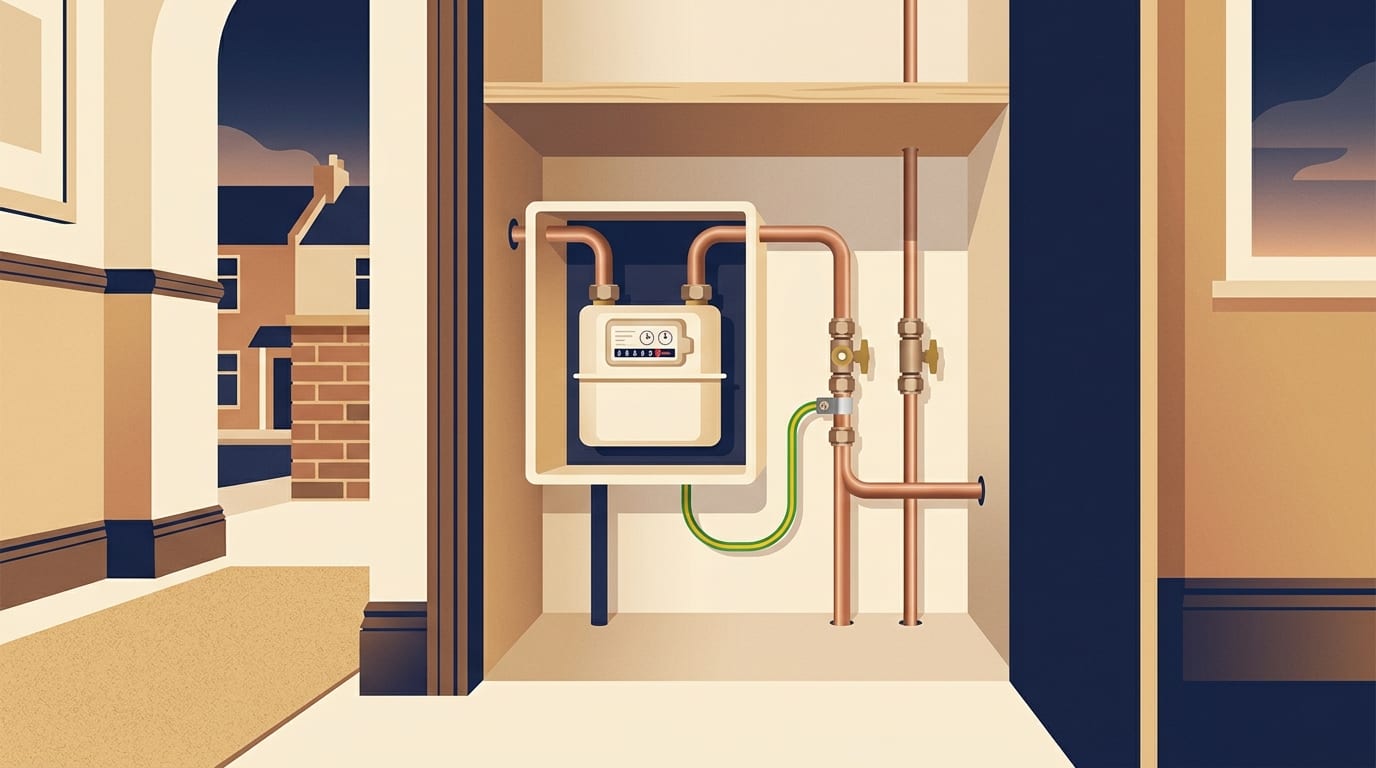
Earth bonding connects metal pipes and other metalwork entering your home to the main earthing terminal, so that if there is a fault the voltage between metal parts you could touch at the same time stays low. Missing main bonding to incoming metal pipes is usually coded as potentially dangerous on an electrical inspection report.
What earthing and bonding do
Earthing and bonding are two distinct methods used to prevent electric shock in your home. While people often use the terms interchangeably, they do different jobs. Earthing protects you by providing a path, known as a protective conductor, for a fault current to flow to earth. If a live wire comes loose and touches the metal casing of an appliance, the earthing arrangement ensures that the fault current flows safely away. This flow of current ensures that the protective device, such as a fuse, circuit breaker or RCD, switches off the circuit with the fault immediately.
Bonding reduces the risk of an electric shock to anyone who touches two separate metal parts when there is a fault somewhere in the supply or installation. It does this by connecting bonding conductors that reduce the voltage there might have been between those parts. If a fault makes one metal pipe live, bonding keeps the voltage between that pipe and other bonded metalwork low, so much less current could flow through your body if you touched both at the same time.
The types of bonding generally used in UK homes are main bonding and supplementary bonding. If you are having any electrical work done, your electrician must check that your earthing and bonding arrangements are up to the required standard. This matters because the safety of any new work, however small, depends on them. A registered electrician can advise if your earthing or bonding needs to be improved for safety reasons.
Main bonding to gas and water pipes
Main bonding connects incoming metal gas and water pipes to the main earthing terminal, which is usually at or near your consumer unit, also called a fuse box or fuse board. You will usually spot it as a thick green and yellow cable clamped to the metal pipework.
The exact position of this connection is important for your safety. Where a gas meter is inside the premises, the bonding connection should be made to your hard metal pipework after the meter and before any branch pipework. Where practicable, it should be within 600 mm of the meter outlet union.
Where the meter is outside in a wall-mounted or semi-concealed meter box, the approach changes slightly. The connection should still be made to the consumer's hard metal pipework before any branch, but where practicable it should be at the point of entry to the building.
If you live in a building of flats where the gas and water meters are main bonded at the main intake position, it is good practice also to provide main protective bonding in each flat. This offers an extra layer of safety for the residents. You should never try to open a consumer unit, remove covers, or touch the wiring to check these connections yourself.
Supplementary bonding in bathrooms
Supplementary bonding is a local connection used in specific higher-risk areas, mostly bathrooms and shower rooms. Instead of running a long cable back to the consumer unit, it connects metal pipes and the earth connections of local circuits together within the room itself.
Wet environments drastically reduce the natural electrical resistance of human skin. Because of this, bathroom circuits require extra care to prevent severe electric shocks. If there is a fault, supplementary bonding keeps the voltage between metal parts in the room low, which reduces the risk of a shock while you are wet.
The national wiring standard, BS 7671 or the Wiring Regulations, allows this local bonding to be left out only when certain conditions are all met, and your electrician will check whether they apply. If you are unsure whether your bathroom is safe, an electrician can check the bathroom electrical zones and test the circuits.
Why a gas engineer may flag missing bonding
Many homeowners only discover they have an earth bonding issue when a gas engineer visits to service a boiler, cap a pipe or fit a smart meter. Gas engineers do not usually fit bonding themselves, but when they connect pipework to a gas meter the law requires them to tell you if bonding may be needed.
Under regulation 18(2) of the Gas Safety (Installation and Use) Regulations 1998, any person who connects any installation pipework to a primary meter has a specific duty. In any case where electrical equipotential bonding may be necessary, they must inform the responsible person that such bonding should be carried out by a competent person.
This is why a gas engineer may tell you, or note on their paperwork, that the bonding should be checked. The regulation says the bonding should be carried out by a competent person, which in practice means booking a registered electrician.
What an EICR says about bonding
An electrical installation condition report is a formal inspection of your property's wiring. The inspector uses specific codes to grade the safety of your installation. According to the industry Best Practice Guide 4, these are the standard classification codes used:
- C1 danger present, risk of injury, immediate remedial action required.
- C2 potentially dangerous, urgent remedial action required.
- C3 improvement recommended.
- FI further investigation advised.
The absence of effective main protective bonding of extraneous-conductive-parts entering the building is coded C2. This means it is potentially dangerous and urgent remedial action is required. An inadequate cross-sectional area of a main protective bonding conductor, where it is less than 6 mm2 or there is evidence of thermal damage, is also coded C2.
Missing supplementary bonding where it is required in a location containing a bath or shower is coded C2 as well, unless all of the requirements permitting omission are met. If a main protective bonding connection to a gas, water or other installation pipe is inaccessible for inspection, testing and maintenance, it is coded C3. A C3 code is also given if main protective bonding is connected to branch pipework where continuity is not assured.
If an EICR gives bonding a C2 code, arrange the remedial work promptly, as the code means it is urgent. If you ever think you have an unsafe electrical installation, first warn everyone to stay away from it. If it is safe to do so, switch it off at the main switch, then contact a competent person such as an approved contractor from the ECA, NAPIT, NICEIC or SELECT.
Bonding that is not required
Some older inspection reports or overly cautious quotes might suggest that every piece of metal in your house needs a bonding cable attached to it. This is not the case, and you should be wary of paying for remedial work that is not actually required by the Wiring Regulations.
The industry Best Practice Guide lists several common myths. These are items that are not non-compliances with BS 7671 and do not require reporting. For example, the absence of earthing or bonding to metallic sinks and baths is a myth, unless they are extraneous-conductive-parts in their own right. An extraneous-conductive-part is simply a metal item that can introduce a voltage into the room from outside, such as a metal water pipe coming straight from the ground.
The guide also lists the absence of bonding connections to boiler pipework as a myth, provided the pipework is not an extraneous-conductive-part in its own right. Whether bonding is genuinely needed depends on the specific pipework and how it connects to the ground. Your electrician will decide this through careful inspection and testing, rather than just guessing based on the presence of metal.
Who should fit or upgrade bonding
Use a registered electrician to fit or upgrade your earth bonding. They have the training and test equipment to check the bonding and earthing connections once the work is done. Electrical work in homes in England and Wales is covered by Part P of the Building Regulations, while Scotland and Northern Ireland have their own building standards systems.
Electricians registered with a government-authorised competent person scheme, for example NICEIC, run by Certsure, or NAPIT, can self-certify notifiable work. If an unregistered person does notifiable work, building control must be told before it starts. After notifiable work the customer should receive the electrical certificate and a Building Regulations compliance certificate, and should keep both safe for when the property is sold.
Under the Consumer Rights Act 2015, any service you pay for must be carried out with reasonable care and skill. If an electrician does a poor job or leaves the bonding disconnected, you have the right to ask for the work to be put right at no extra cost. Services arranged at home, by phone or online usually carry a 14-day cooling-off period, though this does not automatically apply to urgent repairs you have specifically asked for.
What it costs to put right
Because earth bonding involves running a cable from your consumer unit to your gas and water meters, the price depends heavily on the route. There is no typical published price for bonding on its own. Small jobs and fault finding are usually charged by the hour, often with a call-out fee or minimum charge that covers the first hour. London and the South East cost noticeably more, running roughly 15 to 30% higher than the North of England, Wales and Scotland.
If the electrician can run the bonding cable along the surface of a wall or neatly inside plastic trunking above your skirting boards, the labour cost will stay low. If you want the cable hidden completely out of sight, they will need to lift carpets, pull up floorboards and drill through wooden joists. This takes significantly more time and pushes the price towards the higher end of the day rate.
Often, bonding upgrades are quoted as a fixed price as part of a larger job. For example, a consumer unit replacement with bonding upgrades and a surge protection device typically costs £650 to £900. A quote is a fixed price, but an estimate is not and can change if the electrician runs into difficulties.
This table shows typical published hourly and daily rates for electricians.
|
Service |
Outside London |
London and South East |
|---|---|---|
|
Standard hourly rate |
£40 to £60 |
£55 to £75 |
|
Call-out fee (normally includes first hour) |
£60 to £120 |
£90 to £150 |
|
Half day (about 3 to 4 hours) |
£120 to £220 |
£180 to £280 |
|
Full day (7 to 8 hours) |
£220 to £400 |
£300 to £450 |
|
Emergency or out-of-hours call-out |
£120 to £350 |
£180 to £400 |
These figures are typical published prices for 2026 including VAT. Your local quotes will differ based on the exact cable route, access and whether you need out-of-hours service.
Questions to ask your electrician
When you invite an electrician to quote for earth bonding, you need to know exactly what is included. Vague quotes that leave out making good, certification or VAT are a common problem for customers. Ask these questions before you agree to any work.
- Which specific pipes need main bonding and why?
- What code was this given on the report, and why?
- How will you route the cable, and will it be hidden under floors or run in surface trunking?
- Does your quote include making good any plaster, skirting boards or floorboards you have to lift?
- Is VAT fully included in the price you have given me?
- Which certificate will you give me when the job is finished?
Common questions
What is equipotential bonding?
Equipotential bonding is the technical term for connecting metalwork together so that, during a fault, the voltage between metal parts you can touch stays low. The smaller that voltage difference, the less current could flow through your body from one part to another. Main bonding and supplementary bonding are both types of equipotential bonding used in UK homes.
What are the gas meter earth bonding regulations?
Under the Gas Safety (Installation and Use) Regulations 1998, anyone who connects pipework to a gas meter must tell the responsible person when electrical bonding may be needed and that it should be done by a competent person. The actual electrical rules for how and where the bonding is fitted are found in the national wiring standard, BS 7671. This standard states that the connection should normally go on your hard metal pipework after the meter, within 600 mm of the outlet where practicable.
Who is responsible for earth bonding a gas meter?
The gas engineer's duty is to tell the responsible person, usually the person living in the property, that bonding should be carried out by a competent person. Arranging the work then falls to you as the owner, or to your landlord if you rent. The bonding connects to your own pipework after the meter. Landlords have a legal duty to have the electrical installation inspected at least every five years, with nation specific rules and substantial penalties in England for non-compliance, while for owner-occupiers periodic inspection is a recommendation.
What happens if I have no earth bonding on my gas meter?
If a fault develops in your electrical system or even out in the street supply, your metal gas pipes could become live. Without main bonding to keep the voltage between metal parts low, you could get an electric shock if you touched the pipe and other earthed metalwork at the same time. This is why missing main bonding to incoming metal pipes is coded C2, potentially dangerous, on an EICR.
Next steps
If a gas engineer or an EICR has flagged your earth bonding as missing or inadequate, you should act to put it right. It is a vital safety measure that protects anyone living in or visiting your property.
- Check your most recent electrical certificate or inspection report to see exactly what code the issue was given.
- Look near your gas and water meters for a green and yellow cable clamped to the pipework, but never touch, tighten or move it yourself.
- Search the competent person scheme registers online to check that any electrician you contact is properly registered.
- Ask two or three registered electricians to look at the required cable route and give you a fixed quote for the work.
- Check that each quote includes VAT, certification and making good any disruption to your walls or floors.
Taking the time to compare detailed quotes ensures you get a fair price and the right paperwork. When you are ready to get the work sorted, find an electrician near you to make your home safe.
Related Guides

Emergency Lighting Rules and Testing for Businesses and Landlords
Who has to provide emergency lighting, when shops, offices, HMOs and blocks of flats need it, maintained and non maintained systems explained, and how often it should be tested.
Fishy or Burning Smell in Your House and When It Is Electrical
Why overheating sockets and wiring can smell of fish or burning plastic, what to do straight away, how to tell it apart from a gas smell and what an electrician will check.
Plug Socket Not Working and When to Call an Electrician
Why a plug socket or a group of sockets stops working, the safe checks you can make first, the signs that mean stop using it now and what an electrician typically charges in 2026.