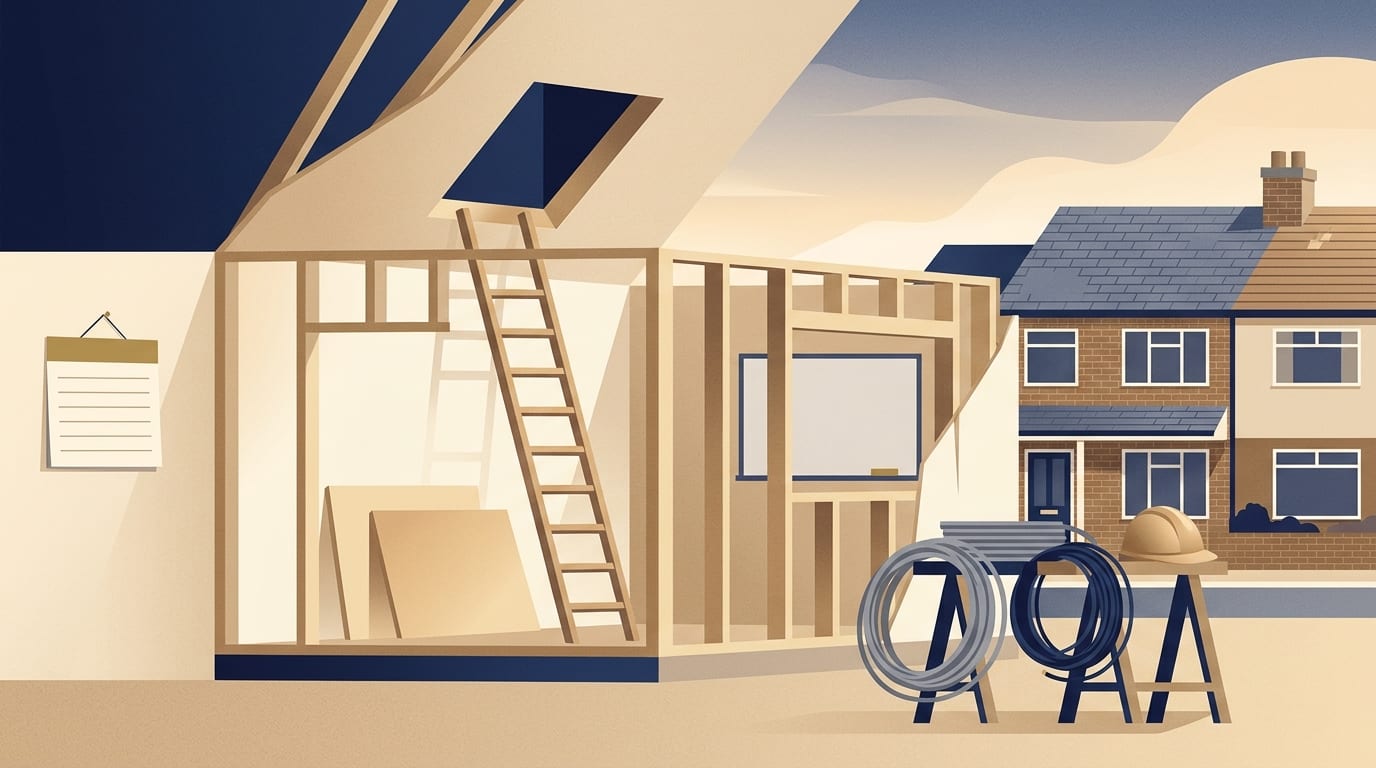
When you are planning an extension or loft conversion, the first fix electrical work must be completely finished before the walls are plastered. You should book an electrician early in the project and agree the order of work in writing with your builder. This ensures all the cables are safely hidden in the walls and ceilings, ready for the final connections once the decorating is done.
Why the electrician needs to be involved early
Electrics are very easy to forget in a build until the walls are plastered and painted. If the plastering happens before the wiring is finished, the new plaster will have to be cut open to run the cables. This causes serious delays, creates extra mess and costs you more money to fix. Booking an electrician early prevents these entirely avoidable problems.
Your builder will manage the main construction, but they cannot simply assume the electrics are covered by the main building control notice. Electrical work has its own strict safety and certification rules that must be followed independently. You must ask your builder right at the start who is responsible for providing the final electrical certificate. In most cases, you need a registered electrician to sign off their own work directly.
Agreeing lead times in writing with your builder and your electrician is a sensible step. It means everyone knows exactly when the site will be ready for the wiring to begin. A well organised project keeps the trades moving smoothly without people waiting around for someone else to finish. It also ensures the electrician has enough time to plan the cable routes safely.
First fix and second fix in a build
Electrical work on an extension or loft conversion happens in two main stages. These are known in the trade as first fix and second fix. Understanding the difference helps you track what you are paying for and when the work will actually happen.
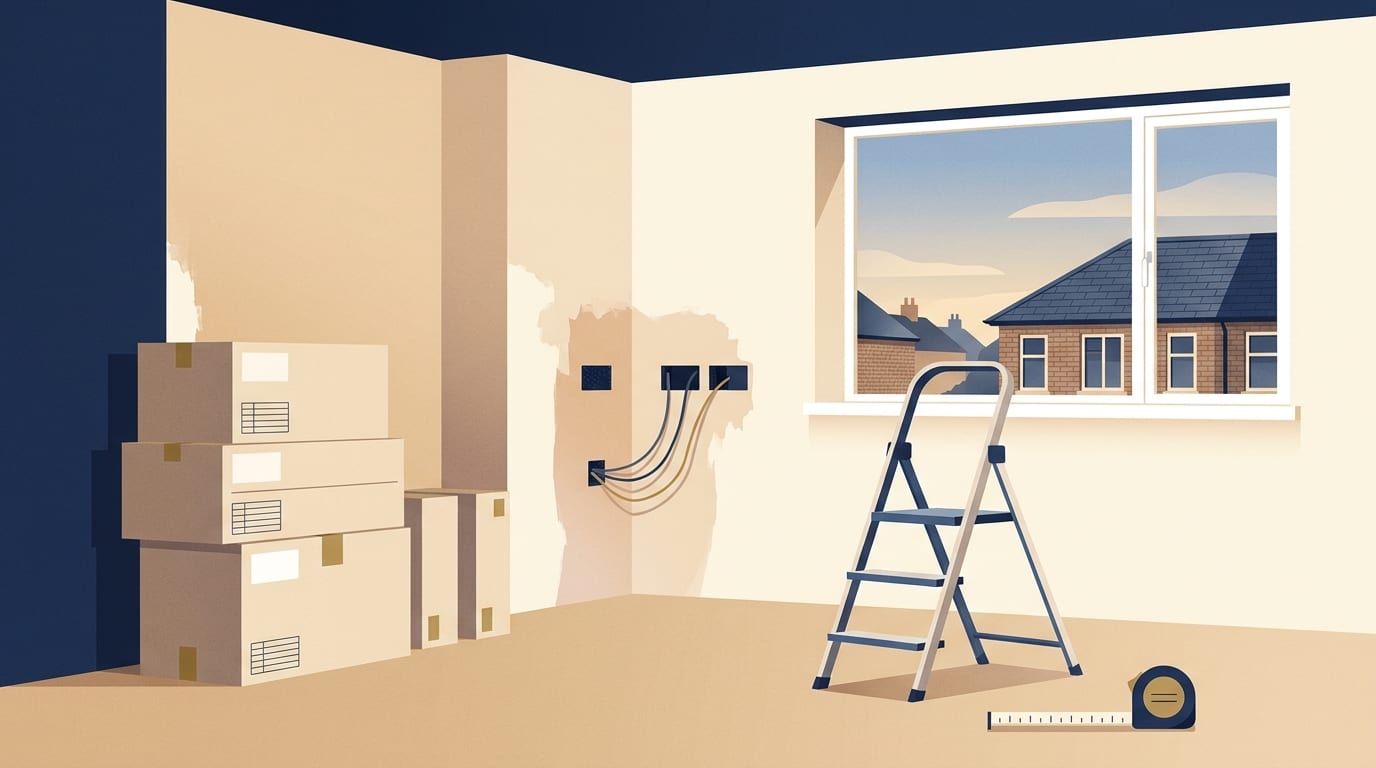
First fix is all the electrical work done before the walls are plastered. This is the messy stage where the physical routes for your power are created. The house will be very dusty, floorboards will probably need to be lifted, and channels may be cut into the brickwork.
First fix work typically includes:
- Running cables through walls, under floors and across ceilings
- Installing the metal or plastic back boxes for sockets and light switches
- Positioning the consumer unit if a completely new one is being fitted
- Preparing the wiring routes across multiple floors to handle the new load
- Running the cables for any mains powered smoke alarms
Second fix is the work carried out after the plastering and decoration are completely finished. The electrician returns to a clean site to make the final connections and bring the system to life. The heavy construction is over by this point.
Second fix work typically includes:
- Fitting the plastic or metal faces to the plug sockets and light switches
- Installing light fittings, extractor fans and any fixed appliances
- Connecting the new wiring safely to the consumer unit
- Testing the whole new installation with specialist equipment
- Issuing the final Electrical Installation Certificate to the homeowner
Will your existing consumer unit cope
Before adding any new wiring for an extension, the electrician must thoroughly check your existing setup. The national wiring standard is BS 7671, which is often called the Wiring Regulations. Under Regulation 132.16, the rating and condition of your existing equipment must be adequate for the additional load you want to add.
This strict rule also applies to the distributor equipment, which is the main fuse and meter setup belonging to the electricity network. If your new extension includes heavy power users like electric heating or an induction hob, the incoming supply might need an upgrade. The existing earthing and bonding arrangements must also be completely adequate. The electrician will check the thick green and yellow cables connecting your gas and water pipes to the main earth terminal.
If your current consumer unit, also known as a fuse box or fuse board, is old, full or unsafe, it may not support the new extension. Modern consumer units contain safety switches called RCDs or RCBOs that cut the power instantly if a fault is detected, along with a surge protection device to stop power spikes damaging your electronics. The electrician may recommend replacing your consumer unit before starting the new work. Compliance with BS 7671 must be carefully verified for every addition or alteration to your home.
New circuits and notification
Building an extension or converting a loft usually adds new electrical circuits to your home. In England, installing a complete new circuit or replacing a consumer unit is classed as notifiable work under Part P of the Building Regulations. You can read more about these general rules on the Planning Portal.
Notifiable work also includes any addition or alteration to an existing circuit in a special location. In England, special locations are specifically the spaces around baths and showers. In Wales the list is broader, and special locations include kitchens and outdoors as well. Scotland has its own building standards system and Northern Ireland differs, so you must always check with your local authority building control department.
If you hire an electrician who is registered with a government-authorised competent person scheme, such as NICEIC or NAPIT, they can self-certify their own notifiable work. If an unregistered person does notifiable work, building control must be told before it starts. Alternatively, a registered third party certifier must be appointed before the work begins.
All electrical work, whether it is notifiable or not, should be designed, installed, inspected, tested and certified in accordance with BS 7671. You should always ask for the correct electrical certificates at the end of the job to prove the work is safe and legal.
Smoke alarms and loft conversions
A loft conversion changes the layout of your home and directly affects how you would escape a fire. The rules for loft conversion fire safety are strict because it is simply too dangerous to escape via windows from floors above first floor level. Building control sets the exact requirements for your specific property and you must follow them.
Under the Planning Portal guidance on loft conversions, mains powered, interlinked smoke alarms will need to be provided within the stairway at each level. Interlinked means that if one alarm detects smoke, every alarm in the house will sound at the same time. This ensures everyone in the property is warned immediately.
When converting an existing roof space into a room, the provisions for escape need to be considered throughout the full extent of the escape route. For a loft conversion on a standard two-storey house, this may mean fitting heavy new fire resisting doors. Sometimes partitions are also required to protect the stairway and ensure a safe, fire resistant path out of the building.
Your electrician will install the hidden wiring for the mains powered smoke alarms during the messy first fix stage. They will then fit the alarm units to the ceilings and test the interlinked system during the second fix.
Typical costs and staging payments in 2026
Electrical work for small jobs and fault finding is usually charged by the hour, often with a call-out fee or minimum charge that covers the first hour. Defined jobs such as an Electrical Installation Condition Report (EICR), a consumer unit replacement, a rewire or an extension are usually quoted as a fixed price based on property size, number of circuits, access and specification. Most electricians charge between £200 and £400 per day for their time.
The table below shows typical 2026 prices. The first fix price is based on a single-storey rear extension that is roughly the equivalent of two rooms. The second fix prices are listed per point, which means you pay for each socket or switch that is fitted.
|
Electrical task |
Typical labour price |
|---|---|
|
First fix (two room extension) |
£500 to £1,000 |
|
Consumer unit connections |
£150 to £300 |
|
Extractor fan second fix |
£40 to £80 |
|
Light fitting second fix |
£20 to £40 |
|
Double socket second fix |
£20 to £30 |
|
Single socket second fix |
£15 to £25 |
|
Light switch second fix |
£15 to £25 |
These figures are typical 2026 prices and represent labour only. They do not include the cost of materials like the cables, sockets, switches and the consumer unit itself. Local quotes will differ, and electricians in London and the South East cost noticeably more. out-of-hours work typically carries a premium.
When checking your quotes, look closely at exactly what is included in the final figure. Quotes may or may not include VAT, materials, testing, certification and making good the plaster and decoration. A quote is a fixed price that you can rely on to budget your build. An estimate is just a rough guess and the final bill can end up being much higher.
You should never be asked to pay the full price of an electrical installation upfront. Staged payments protect both you and the electrician, ensuring the money moves as the work progresses. A demand for a large cash deposit with no paperwork is a warning sign. For extension work, many electricians invoice 60 per cent on first fix completion. The remaining 40 per cent is invoiced on second fix and certification.
Under the Consumer Rights Act 2015, a service must be carried out with reasonable care and skill. If the work is poor or unsafe, you can ask for it to be put right at no extra cost to you. Services arranged at home, by phone or online usually carry a 14-day cooling-off period. This gives you the right to cancel, though it does not automatically apply to urgent repairs you have specifically asked for. If you have a dispute, Citizens Advice can offer guidance for your specific situation.
Planning sockets, lighting and outdoor power
An extension gives you a blank canvas for your electrics, so you need to think carefully about how you will use the space before the first fix begins. Once the cables are buried and the new walls are plastered, adding extra sockets or moving light switches is messy, disruptive and expensive.
Walk through the architectural plans with your builder and your electrician early on. Mark out exactly where the beds, desks or kitchen units will go. This helps you position the sockets so they are not uselessly hidden behind heavy sofas or wardrobes. Think about where you will plug in the vacuum cleaner, charge your phone or set up a television.
If your new extension opens out into the garden, this is the perfect time to plan your outdoor power. Running a cable for an outside socket or security lighting can be easier while the indoor walls are still exposed. It saves the electrician from having to drill through freshly painted walls later on.
Certificates at the end of the project
The paperwork is just as important as the physical wiring in your new extension. An electrical installation is never truly finished until it has been thoroughly tested and certified. You need these documents to prove your home is safe and meets national safety standards.
You should receive an Electrical Installation Certificate for any new circuits or a new consumer unit. For smaller additions that do not require a complete new circuit, a Minor Works Certificate is used instead. The electrician must provide the correct certificate to the person ordering the work as soon as the testing is finished.
If the work is notifiable under the Building Regulations, you will also receive a Building Regulation Certificate of Compliance, which is often referred to as a Part P certificate. You should keep both the electrical certificate and the compliance certificate in a safe place alongside your other building documents. You may well be asked to show them to your buyer's solicitor when the property is sold in the future.
For owner-occupiers, periodic inspection of the electrics is a recommendation, not a legal duty. However, landlords have legal duties to have installations inspected at least every five years, with nation specific rules and substantial penalties in England.
Common questions
Can my builder sign off the electrical work?
A builder cannot sign off electrical work unless they are also a qualified electrician registered with a competent person scheme. The electrical installation must be tested and certified separately from the main building work. Always ask your builder who will be issuing the Electrical Installation Certificate.
Do I have to upgrade my earthing for an extension?
Yes, if your current earthing is inadequate. The wiring regulations require that existing earthing and bonding arrangements are completely adequate before any new circuits are added. Your electrician will test the connections to your gas and water pipes and upgrade them if necessary.
Are electrics in a loft conversion notifiable?
It depends on what is being installed. If the loft conversion requires a complete new circuit to be run from the consumer unit, that work is notifiable in England and Wales. Adding a spur to an existing circuit in a dry room is generally not notifiable in England, but you must still receive a Minor Works Certificate.
What happens if I use an unregistered electrician?
If you use an unregistered person for notifiable work, building control must be told before the work starts. The local authority may charge for inspecting the work, or you can appoint a registered third party certifier before the project begins. It is usually much easier to hire a registered electrician who can self-certify.
Next steps for your project
Before you hire an electrician for your extension or loft conversion, make sure you have everything clear in writing. Taking a few simple steps early on will protect you from unexpected costs and disputes later.
Ask these questions before you book the work:
- Ask if they are registered with a competent person scheme like NICEIC or NAPIT
- Check if they will be issuing the Electrical Installation Certificate themselves
- Ask if the quote includes the cost of all materials and VAT
- Check if the price covers making good the plaster around the new sockets
- Agree the lead times in writing with both your builder and the electrician
- Confirm the payment will be split between the first fix and second fix stages
TopRatedElectricians.co.uk is a directory that helps you find and compare local tradespeople based on their customer reviews. The site does not employ, vet, certify or guarantee anyone, so you should always check a firm's registration and ask for a detailed quote. You can use the directory to find an electrician near you and get your project started safely.
Find a top rated electrician near you
4,987 electricians across the UK, each ranked on their Google rating and the number of reviews behind it. Start with your county: