An RCD (residual current device) is a safety switch in your consumer unit that is there to protect people from electric shock. It monitors the electrical current and has ratings in milliamps, making it far more sensitive than standard circuit breakers or fuses. The only check you should do as a householder is to press its test button to ensure it switches the power off instantly when something is wrong.
What an RCD is and how it protects you
Your consumer unit, also called a fuse box or fuse board, is the main control centre for the electricity in your home. It divides the power into different circuits, which are the individual loops of wiring that supply your lights, sockets and appliances. Inside the consumer unit, you will find several switches that control these circuits.
The most important switch for your personal safety is the RCD. RCDs are required to protect people from electric shock. If a person touches a live wire or a faulty appliance, the electrical current will take a different path to the ground. The device detects this tiny imbalance in the current and switches the power off instantly.
Because RCD ratings are in milliamps, they are far more sensitive than circuit breakers or fuses. A standard circuit breaker is designed only to protect your cables from overloading, whereas an RCD is designed to save a life. Under the national wiring standard, known as BS 7671 or the Wiring Regulations, all circuits within the domestic installation will have requirements for additional protection by means of an RCD.
It is important to understand that an RCD does not prevent all shocks or fires. You might still feel a shock before the power cuts out, but the device is there to protect people from electric shock.
How to spot an RCD in your consumer unit
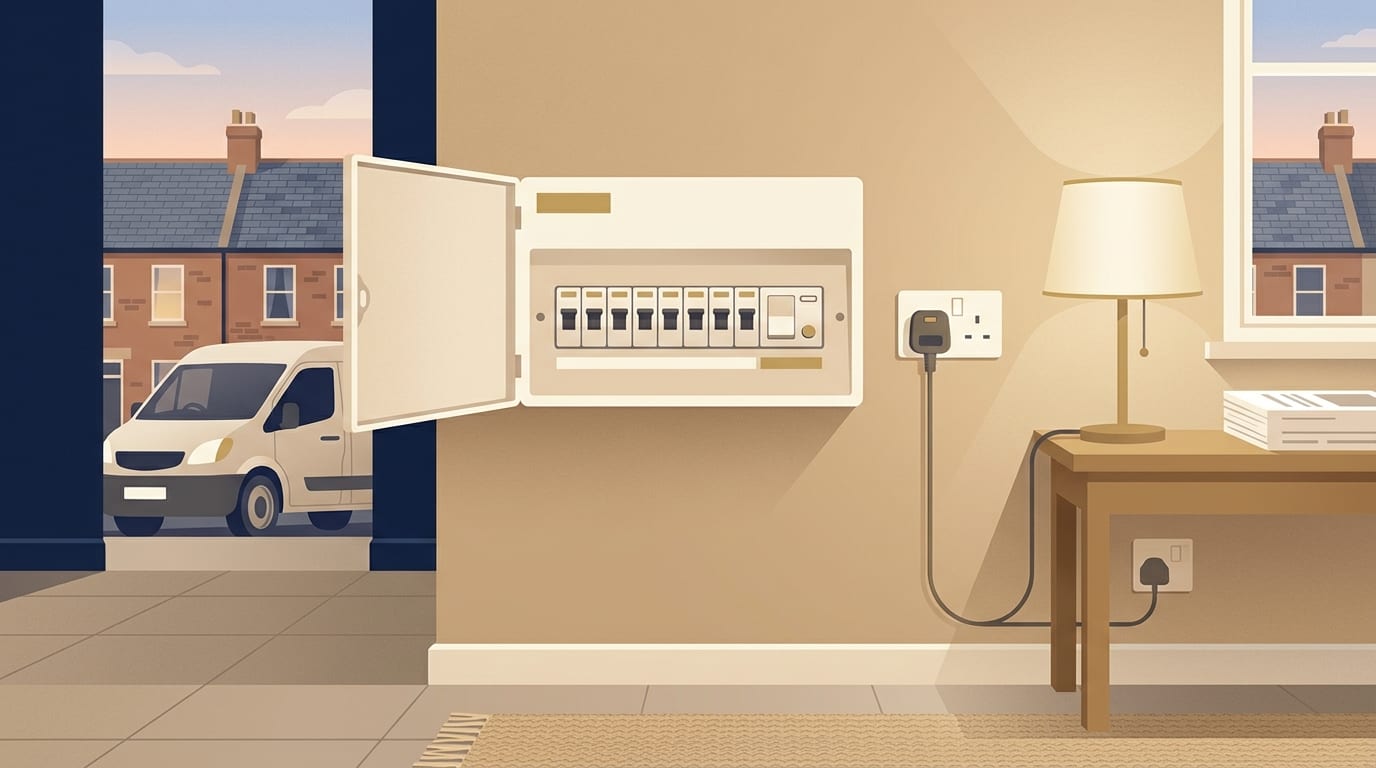
To find out if your home is protected, you need to look at your consumer unit. According to Electrical Safety First, you can check for an RCD by looking for a "Test" or "T" button on the unit.
Pressing it will switch off the power to the areas of the home it protects. In many modern homes, you might have two of these devices, each protecting half of your circuits. This setup ensures that if one trips, you are not left completely in the dark.
In the newest installations, you might see a row of identical switches that each have their own test button. These are called RCBOs. An RCBO is a combined switch that does the job of both an RCD and a circuit breaker in one unit, meaning a fault on one circuit will not affect any of the others. You might also see a surge protection device, which protects your home against voltage spikes from lightning strikes, though this does not have a test button for shock protection.
How to test your RCD safely
Testing your safety switch is a simple process, but you need to prepare first. Because pressing the button will cut the power to the circuits it protects, you must save any work on a computer first. Expect clocks, ovens and appliances on that circuit to switch off and need resetting afterwards.
Guidance from the IET says to test at a maximum frequency of six months, as RCDs incorporate a test button to prove the mechanical operation of the device. However, you should always follow any label on your consumer unit because advice differs depending on the manufacturer.
Follow these steps to test yours safely:
- Save your work on any desktop computers and turn them off.
- Locate your consumer unit and look at the switches on the front.
- Find the switch marked with a 'T' or 'Test' button.
- Press the button firmly and expect the power to cut out immediately.
- Push the switch back up to the on position to restore your electricity.
- Walk around your home to reset your oven clock and any other appliances.
The only check a householder should ever do is press this test button. You should never remove covers, open a consumer unit or touch the wiring inside.
What the test results mean
This table shows the possible outcomes when you press the test button on your consumer unit, what each result means, and what you should do next.
|
What you see |
What it means |
What to do |
|---|---|---|
|
Trips and resets when tested |
The mechanical operation of the device is working correctly. |
Restore your clocks and appliances. Test again in six months or as the label directs. |
|
Does not trip when tested |
The device may not be working. |
Get a registered electrician to investigate. If a replacement consumer unit is needed, the IET gives typical costs of £500 to £2,000 including installation. |
|
Keeps tripping |
There is a fault in an appliance or your wiring that is triggering the safety switch. |
Unplug recent appliances. If it continues, leave it off and call an electrician. |
Local quotes will differ.
What to do if the test button fails
If you press the test button and nothing happens, the device may be faulty. RCDs can be regularly checked using the test button on the device, and if this doesn't work, you should get a registered electrician to investigate. Do not rely on a device that does not trip when tested.
When an electrician visits to investigate a broken switch, you may also consider having your installation properly checked. This is done through an EICR, which stands for Electrical Installation Condition Report. This thorough inspection tests your earthing and bonding, which are the safety connections to metal pipes and the ground, as well as the condition of your cables and the safety of your consumer unit.
The rules for an EICR depend heavily on your situation. Landlords have legal duties to have installations inspected at least every five years, with nation specific rules and substantial penalties in England if this is ignored. For owner-occupiers, periodic inspection is a recommendation, not a legal duty.
Defined jobs such as an EICR or a consumer unit replacement are usually quoted as a fixed price based on property size, number of circuits, access and specification. Remember that a quote is a fixed price, whereas an estimate is not. Quotes may or may not include VAT, materials, certification and making good plaster and decoration, so always check the details before you agree to the work.
Why an RCD keeps tripping on its own
Sometimes your safety switch will trip on its own, cutting the power unexpectedly. If an RCD keeps tripping there is likely to be a fault that needs investigating. This fault will either be in an appliance you have plugged in, or in the hidden wiring of your home.
If you want to understand why your electricity keeps tripping, the first step is a safe user level action. Unplug any appliances you have recently plugged in, then get an electrician to investigate if it keeps tripping.
If it keeps tripping, the fault may be in the wiring, so you must call a registered electrician to trace the problem. Small jobs and fault finding are usually charged by the hour, often with a call-out fee or minimum charge that covers the first hour of their time.
Never try to force the switch to stay up, and never attempt to bypass or tamper with the device. Electricity is dangerous, so keep away from any damaged equipment. If you experience a complete power cut that affects your neighbours too, call 105. If there is a fire or a serious electric shock, call 999 immediately.
Older homes without RCD protection
Many older properties still have their original wiring and fuse boards. Older consumer units may lack an RCD or circuit breakers entirely. However, this does not automatically mean they are unsafe or in need of an immediate upgrade.
An EICR will tell you if yours is still safe or not. For owners of older properties such as 1980s houses, you may wish to consider adding RCDs to enhance the safety of the installation. If a fusebox lacks RCD protection, upgrading is recommended but it is not urgent.
If you are researching consumer unit replacement cost, remember this is a major job. Typical costs for a domestic consumer unit can range from £500 to £2,000 including installation. The final price depends on the size of your property, the number of circuits and the specification. London and the South East cost noticeably more than other areas, and out-of-hours work carries a premium.
From January 2016 consumer units in domestic premises were manufactured from non-combustible material, with the aim of containing any fire within the enclosure. This means a unit fitted today is made of non-combustible material.
Using plug in RCDs for immediate protection
If an RCD is missing from your consumer unit, or it is not working, you should use plug-in RCDs for all the sockets in your home. This provides a practical way to protect yourself while you wait for a registered electrician to upgrade your main board.
A plug-in device looks similar to a standard plug adaptor. You push it directly into your wall socket, and then plug your appliance into the adaptor. It provides RCD protection, but only for that specific appliance.
Ask an electrician if you are unsure which sockets they should cover.
Remember to test your plug-in devices just as you would a main switch. They will have their own test button on the front, and you should follow the instructions that come with them.
Rules and protections when hiring an electrician
When you are ready to hire a professional, you need to understand the rules that govern electrical work. Part P of the Building Regulations covers electrical work in homes in England and Wales. Scotland has its own building standards system and Northern Ireland differs, so the exact rules depend on where you live.
For homes in England and Wales, electricians registered with a government-authorised competent person scheme, for example NICEIC, run by Certsure, or NAPIT, can self-certify notifiable work. If an unregistered person does notifiable work, building control must be told before it starts.
After notifiable work, you should receive the electrical certificate and a Building Regulations compliance certificate. You should keep both for when the property is sold. New work is certified with an Electrical Installation Certificate, while small jobs are covered by a Minor Works Certificate.
You are also protected by the Consumer Rights Act 2015. This states that a service must be carried out with reasonable care and skill, and you can ask for poor work to be put right at no extra cost. Services arranged at home, by phone or online usually carry a 14-day cooling-off period, but this does not automatically apply to urgent repairs you have asked for. Citizens Advice can give guidance on your own situation.
Common problems and how to avoid them
Unfortunately, there are common problems customers face when dealing with rogue tradespeople. Being aware of these tactics will help you protect your home and your money.
Common problems you must look out for include:
- Very cheap inspections used to sell long lists of remedial work.
- Advisory items presented as outright failures.
- Being told a full rewire or a new consumer unit is compulsory with no test evidence.
- Unregistered work with no certificate and no notification.
- Vague quotes that leave out making good, certification or VAT.
- Emergency call outs with no price given before attendance.
- Large cash deposits taken with no paperwork provided.
- Choosing a tradesperson on price alone.
Good advice means checking their registration yourself on the competent person scheme websites. Ask what is normal for timescales and disruption, especially during the messy first fix stage of wiring, where cables are run in walls, compared to the cleaner second fix stage when switches are fitted.
If an electrician tells you a full rewire is required, ask to see the test evidence on an EICR. If they cannot provide it, getting a second opinion is sensible. Pay safely in stages, and never hand over a large cash deposit upfront. Please note that this site lists electricians but does not employ, vet, certify or guarantee anyone.
Common questions
Does an RCD prevent all electric shocks?
No. The device is designed to protect people from serious electric shock, but it does not prevent all shocks or fires. You may still feel a brief shock before the device detects the fault and switches the power off, but it is designed to protect people from serious electric shock.
Can I replace a broken RCD myself?
No. Electricity is dangerous, and replacing components inside a consumer unit is a complex job that requires testing with specialist instruments. You must get a registered electrician to investigate and carry out the replacement. The only action you should take is pressing the test button.
Is it illegal to have a consumer unit without an RCD?
Older consumer units may lack an RCD, but this does not automatically make them unsafe or in need of upgrading. BS 7671 is a standard rather than an Act, so ask your electrician if you are unsure what applies to you. An EICR will tell you if yours is still safe.
Why do some switches have a test button and others do not?
The switches with a test button are RCDs or RCBOs, which monitor the current to protect against shocks. The plain switches without a test button are standard circuit breakers, which only protect your cables from overloading and catching fire.
Your next steps
If you are worried about the safety of your electrics, or you have tested your RCD and found it faulty, here is what you should do next:
- Unplug any appliances that might be causing the switch to trip.
- If the test button does not work, buy plug-in RCDs for your sockets as a temporary measure.
- Check the competent person scheme websites to find a registered professional.
- Ask for a clear, fixed price quote that includes VAT, materials and certification.
- Consider booking an EICR to get a full report on the safety of your home.
If you are ready to book an inspection or need a faulty switch replaced, you can find an electrician near you to investigate the problem safely.
Find a top rated electrician near you
4,987 electricians across the UK, each ranked on their Google rating and the number of reviews behind it. Start with your county: