Installing a new socket in a different location typically costs £120 to £250, while replacing an existing socket costs around £75 including labour and materials. The final price depends heavily on the type of wall you have and how far the new socket is from your existing wiring. Adding a socket is a job that must meet UK safety standards, so you will need a qualified electrician to carry out the work and test the circuit.
What adding a socket typically costs in 2026
The cost of your electrical work depends on exactly what you are asking the electrician to do. A simple faceplate swap takes a fraction of the time needed to run entirely new cables through your walls. The table below shows typical prices for different socket installations.
|
Job |
Typical price |
|---|---|
|
Replacing an existing single or double socket |
£65 to £85 |
|
Upgrading a single socket to a double |
£75 to £100 |
|
Replacing a socket with a USB version |
£75 to £110 |
|
Adding a new socket in a fresh location |
£120 to £250 |
These figures are typical published prices for 2026, and your local quotes will differ depending on your property. The materials form a small part of the bill, as the socket itself adds just £10 to £25 to the total depending on the finish you choose. The rest of the cost is labour and testing.
For straightforward jobs, labour is around £40 per socket. If the installation is more difficult and requires lifting floorboards or routing cables through complex spaces, electricians usually switch to an hourly rate. Electricians may charge £40 to £60 per hour for more complex work. You should always ask for a fixed price quote rather than an estimate, as a quote is a firm promise of the final bill.
New socket or replacement
Replacing an existing socket is a fast job because the back box and the wiring are already secure inside the wall. The electrician will turn off the power, unscrew the old faceplate, check the condition of the copper wires and connect the new unit. This is why a simple swap sits at the bottom of the price range. If a plug socket is not working, replacing the faceplate is often the most affordable way to solve the problem.
Upgrading a single socket to a double takes slightly longer. The electrician must remove the existing single back box from the wall and cut a wider hole to fit a double back box. This creates a small amount of dust and rubble, but because the cables are already in the right place, the labour time remains low.
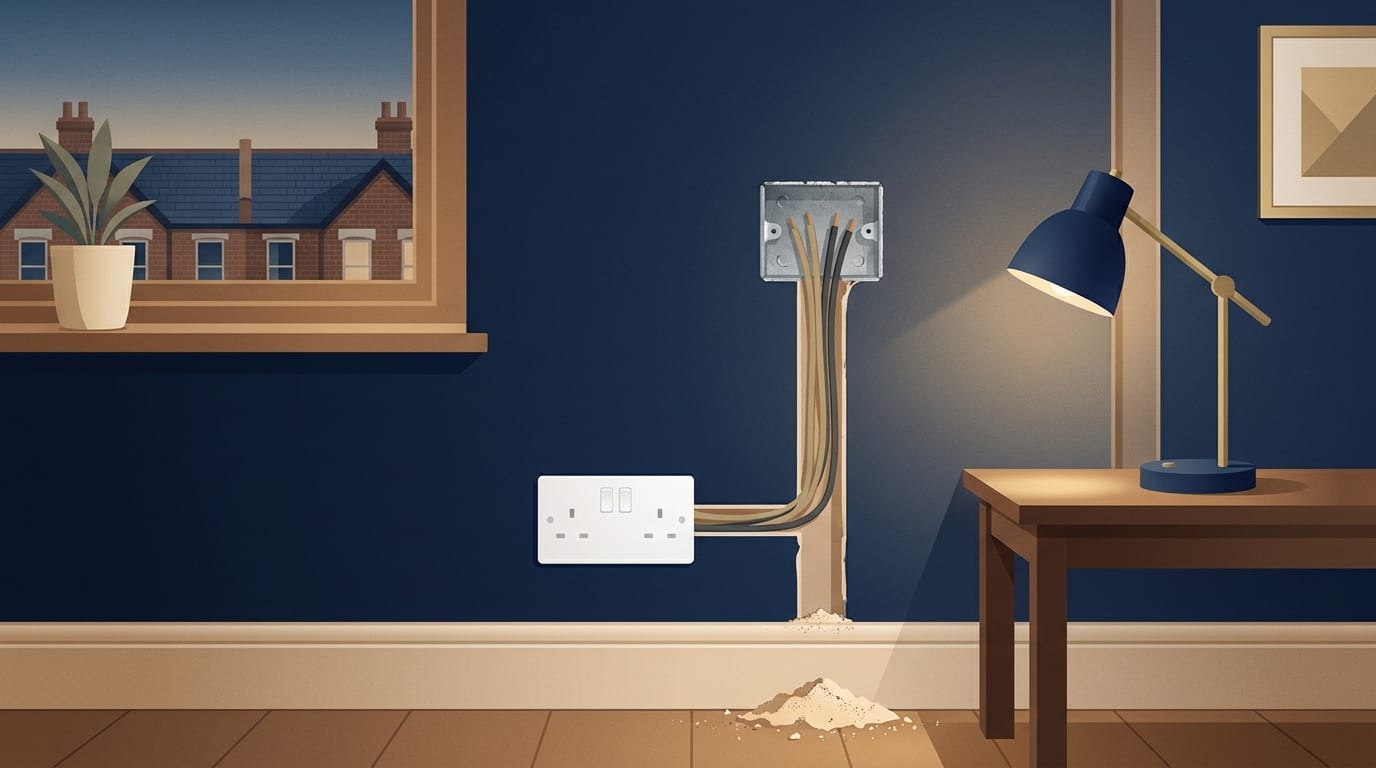
Adding a completely new socket in a fresh location is a much larger physical job. The electrician has to run a new cable from your existing power supply all the way to the new spot. The wall is marked out and chased to accommodate the back box and cable run. This preparation work is the main reason why a new location costs £120 to £250, as it requires heavy tools and creates disruption in the room.
If your existing socket is cracked or exposing wires, stop using it and keep away from the damaged equipment. You can switch off the power at the main switch if it is safe to reach, but never attempt to add sockets, extend cables or open the consumer unit yourself. Extension leads and adaptors are not a safe substitute for needed sockets, so calling a professional is the right choice.
What pushes the price up
There are several factors that decide whether your quote sits at the top or bottom of the expected price range.
- Wall construction dictates the labour time, as solid walls take longer to chase for new cables than stud walls.
- Distance from the existing wiring increases the cost if a new dedicated circuit requires a long cable run under your floorboards.
- Property location affects the quote because electricians in London and the South East have higher operating costs and charge noticeably more.
- Working hours change the hourly rate, with out of hours evening or weekend work carrying a premium charge.
- Socket finishes vary in price, so ask which finish is in the quote.
- Additional features add to the materials bill, as sockets with built in USB ports are more expensive than standard versions.
When you ask an electrician to quote for the work, tell them exactly what type of walls you have and where the consumer unit is located. This helps them calculate the labour time accurately and gives you a more reliable fixed price.
Spurs, ring circuits and new circuits
Most UK homes use a ring main system, where a single cable loops from the consumer unit through several sockets in a room and back again. Adding a socket that can spur off an existing ring main is usually quick and affordable. A spur is a single cable branching off the ring to feed one new socket. Because the distance is short and the main circuit is already in place, the labour time is minimal.
However, a spur is not always the right technical solution. If the existing circuit is already carrying its maximum safe load, or if you need a socket for a heavy kitchen appliance, you might need a dedicated circuit. If the new socket needs its own dedicated circuit, the job will involve more wiring and testing, which raises the cost.
To install a dedicated circuit, the electrician must run a brand new cable all the way from the consumer unit to the new socket location. This longer cable run takes more time to install and requires a complete set of safety tests to prove the new circuit will trip safely in an emergency.
When the consumer unit matters
The consumer unit, often called a fuse box or fuse board, controls and protects all the electrical circuits in your property. Every circuit connects to a circuit breaker or fuse inside this unit. Modern wiring regulations require highly sensitive safety switches called RCDs to protect almost all sockets in a home.
When an electrician adds a new circuit, they must check if your consumer unit has a spare slot to connect it and the correct RCD protection to make it safe. If your consumer unit is already running close to capacity, it may need upgrading before additional sockets can be added safely.
Replacing a fuse box costs £350 to £750. This is a significant extra cost that can surprise homeowners who only wanted a few extra sockets. It is wise to ask the electrician to check your consumer unit during their initial visit. You can read more about what the upgrade involves in our consumer unit replacement guide.
Even for a simple spur, a competent electrician will want to be sure the existing circuit is suitable to extend, and may recommend other work if it is not.
Making good after chasing
Installing a socket in a fresh location involves cutting into your walls. The electrician will use a chasing tool or a drill and chisel to remove masonry and plaster. This leaves a channel for the cable and a deep square hole for the metal back box. Chasing creates fine dust, so you should clear the room and cover heavy furniture before the work begins.
Once the cable and back box are secured to the brickwork, the wall needs to be repaired. Any minor wall damage from chasing or back box fitting may need to be made good. Making good means filling the channels with plaster or filler so the wall is smooth and ready for decoration.
Whether making good and decorating are included varies between quotes. You should always ask the electrician exactly what their quote covers so you know who is responsible for repairing the wall.
Rules and paperwork
Electrical work in homes in England and Wales is covered by Part P of the Building Regulations. Scotland has its own building standards system and Northern Ireland differs again, so the exact rules depend on where you live. In England, the rules dictate which jobs must be reported to your local building control department.
According to Approved Document P, work is notifiable where it consists of the installation of a new circuit or the replacement of a consumer unit. If your new sockets require a dedicated circuit back to the fuse box, the work is notifiable. Electricians registered with a government-authorised competent person scheme, such as NICEIC or NAPIT, can self-certify notifiable work.
Adding a socket to an existing circuit outside a special location is not notifiable. This means a simple spur in a living room or bedroom does not need to be reported to building control. All other electrical installation work is not notifiable, namely additions and alterations to existing installations outside special locations, and replacements, repairs and maintenance anywhere.
Whether the work is notifiable or not, strict safety standards still apply. Non-notifiable electrical installation work, like notifiable work, should be designed and installed, and inspected, tested and certificated in accordance with BS 7671. This is the national wiring standard. Registered competent person installers should complete a BS 7671 electrical installation certificate for every job and give it to the person ordering the work. For a small job like a spur, this paperwork is often called a Minor Works Certificate. You should keep these documents safe for when you sell the property.
Sockets near baths and showers
Water and electricity are a dangerous combination, so bathrooms have special rules for sockets. The space around a bath tap or shower head is classed as a special location. This restricted zone reaches up to 2.25 metres high and extends 0.6 metres horizontally from the edge of a bath or shower tray.
Any addition or alteration to existing circuits in a special location is notifiable work. If you want a shaver socket or an extractor fan connection in this area, the electrician must follow strict safety guidelines and ensure building control is notified.
For standard plug sockets, a note in Approved Document P says socket-outlets should not be located within 3 metres of a bath tub or shower tray. This is guidance, so ask your electrician what applies to your bathroom.
If you are planning a bathroom layout, talk to your electrician early. They can advise on suitable pull cord switches or dedicated shaver sockets that comply with the safety regulations. You can check our guide on bathroom electrical zones for more detail on what equipment is allowed in these wet spaces.
Consumer rights and common problems
Under the Consumer Rights Act 2015, any electrical service must be carried out with reasonable care and skill. If the installation is faulty or the sockets are fitted poorly, you can ask for the poor work to be put right at no extra cost. Services arranged at home, by phone or online usually carry a 14-day cooling-off period, giving you the right to cancel. However, this cooling-off period does not automatically apply to urgent repairs you have specifically asked the electrician to carry out. You can check the Citizens Advice website to see how these rights apply to your specific situation.
Even with these protections, homeowners regularly run into the same frustrating issues when hiring tradespeople.
- Receiving vague quotes that leave out making good, certification or VAT, which leads to unexpected bills at the end of the job.
- Being asked for large cash deposits upfront with no paperwork or formal contract provided.
- Choosing a tradesperson on price alone and receiving unregistered work with no certificate and no notification to building control.
- Being told a full rewire or a new consumer unit is compulsory before a socket can be added, with no test evidence provided to prove it.
- Facing emergency call outs where no price is given before the electrician attends the property.
- Having advisory items on a cheap inspection presented as dangerous failures to pressure you into unnecessary upgrades.
You can avoid most of these problems by insisting on a fixed written quote before the work begins. A reputable electrician will gladly explain what the price covers, provide their scheme registration details and confirm exactly what paperwork you will receive when the job is done.
Common questions
How long does it take to add a socket?
The time depends on the job. A simple replacement is quicker than a new socket in a fresh location, and solid walls take longer to chase for new cables than stud walls. Ask the electrician how long they expect it to take.
Do I need a full rewire if I want more sockets?
You do not necessarily need a full rewire just to add extra sockets. An electrician will test your existing wiring to see if it is safe to extend. If the cables are in good condition and the consumer unit is suitable, they can add spurs or new circuits safely. A rewire is only required if the existing installation is severely degraded.
Can an electrician install sockets in a kitchen?
Yes, electricians regularly add sockets for kitchen worktops and heavy appliances. Kitchens demand careful planning because appliances like ovens and induction hobs draw heavy loads and often require their own dedicated circuits. Sockets must also be placed at a safe distance from sinks to prevent water splashes.
Can I refuse to pay if the wall is left messy?
Cutting into walls inevitably causes disruption and dust. If the written quote said making good and plastering were not included, unfinished plaster may not be a fault in the work, though your rights depend on your situation and Citizens Advice can guide you. This highlights why you must check the quote details carefully before the work begins.
What happens if an electrician finds a fault?
If the electrician finds a dangerous fault while testing the circuit, they must tell you. They cannot safely connect a new socket to a dangerous circuit. You will usually be given a quote to repair the underlying fault before the new socket installation can go ahead.
Next steps before you book
Before you agree to a date for the work, you should ask the electrician a few clear questions to ensure you both understand the job.
- Ask if the new socket will be a spur off the ring main or if it requires a new dedicated circuit.
- Confirm whether your wall is solid or stud so the electrician can estimate the labour time accurately.
- Check if the quote includes making good the plaster and decorating once the chasing is finished.
- Ask if your current consumer unit has the spare capacity and RCD protection required for the new wiring.
- Confirm exactly which certificate you will receive when the job is completed and tested.
- Check that the total fixed price includes the materials, the labour and the VAT.
Adding extra plug sockets makes your home safer by removing the need for trailing extension leads, but it must be done correctly by a registered professional who will test their work. When you are ready to get quotes and check your consumer unit capacity, you can find an electrician near you to discuss the best locations and finishes for your property.